




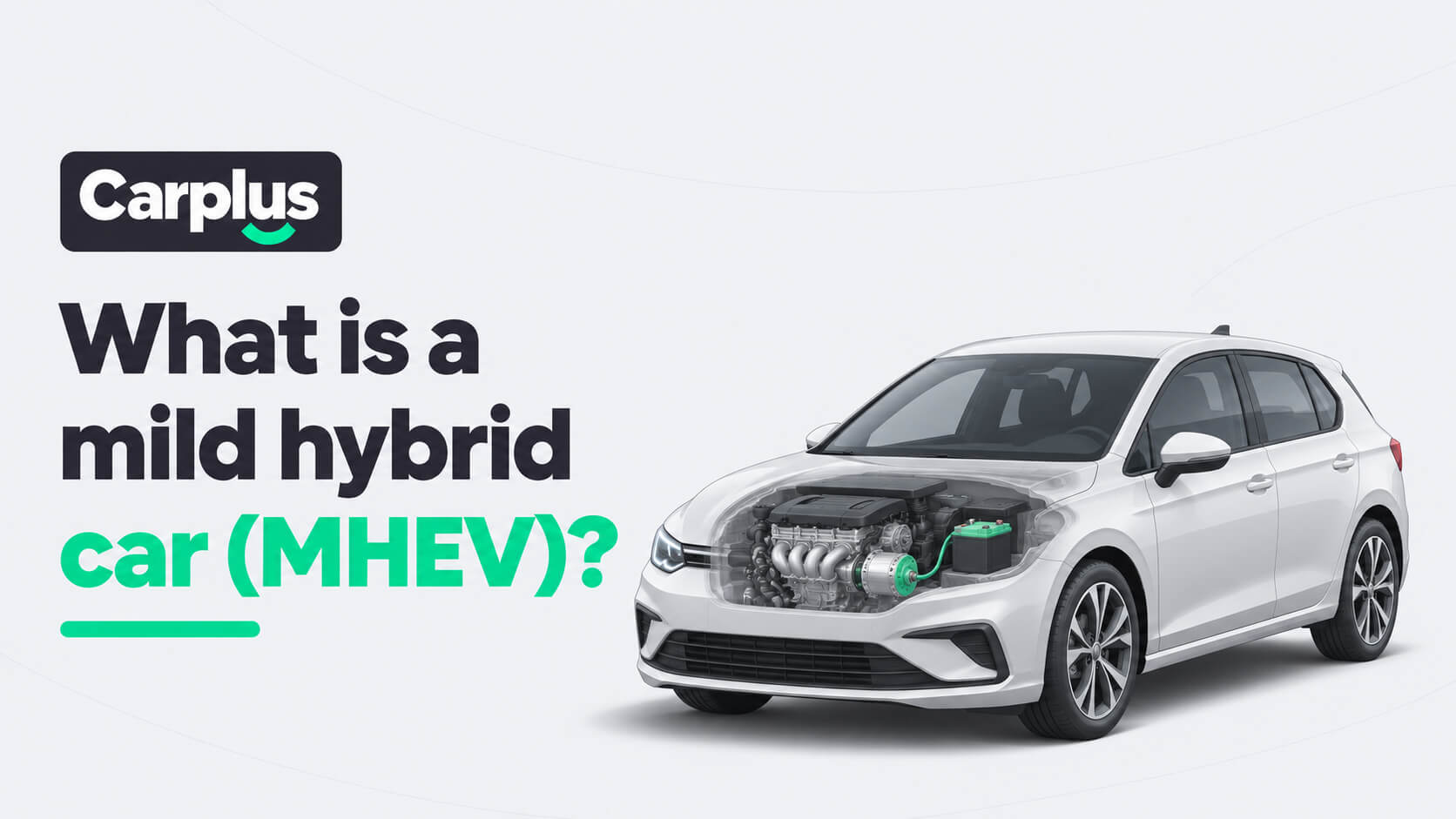
A mild hybrid car (MHEV, short for mild hybrid electric vehicle) is a petrol or diesel car whose small electric motor and battery help the engine, but unlike a full or plug-in hybrid it can't run on electricity alone. Most mild hybrids use a 48V system that recovers braking energy and boosts the engine as you pull away.
Need to plug it in? No, it charges itself from the engine and braking.
What does MHEV stand for?
MHEV stands for mild hybrid electric vehicle, the full name behind the mild hybrid label you'll see in used-car listings. Badges such as MHEV, 48V, SHVS, e-TEC and EQ Boost identify one in an advert or brochure.
Don't rely on the word 'hybrid' on its own. A missing charging socket rules out a plug-in hybrid. But a full hybrid has no socket either, so check the spec sheet before you buy.
Is a soft hybrid the same thing? Yes, a soft hybrid is generally another name for a mild hybrid, and you may also see 'light' or 'semi' hybrid, though not every maker uses these names the same way.
How does a mild hybrid work?
A mild hybrid works by swapping the alternator (the part that keeps a normal car's battery charged) and the starter motor for one electric starter-generator. You can think of it as a helper on the side of the combustion engine: it charges a small 48V lithium-ion battery when you slow down and hands that energy back when you speed up.
- The 48V system. Most modern mild hybrids run a 48V electrical system alongside the usual 12V one, though some smaller or older systems use 12V and give a smaller benefit. At four times the electrical power of a 12V setup, 48V is enough to assist the engine. For the lights, wipers and screen, a DC/DC converter steps it down to 12V.
- The starter-generator. The electric motor in a mild hybrid is a belt-driven or integrated starter-generator (BSG or BISG), which both starts the engine and makes electricity.
- Regenerative braking. Lift off or brake, and it turns energy that would otherwise be lost as heat into electricity for the battery.
- Acceleration assist. Pulling away, the engine gets a small push from the motor, so it works less hard and burns a little less fuel.
- Stop-start. At the lights, the engine switches off. The starter-generator restarts it smoothly and quickly as you move off, and some systems also let the car coast with the engine off at steady motorway speeds.
Can a mild hybrid run on electricity alone? No, its electric motor only assists the engine and can't move the car by itself. That's the engine's job, every time.
How is a mild hybrid different from a full or plug-in hybrid?
A mild hybrid differs from a full hybrid (HEV) and a plug-in hybrid (PHEV) mainly in how far it can drive on electricity alone, which for a mild hybrid is no distance at all. A full hybrid can drive short distances at low speed, typically a mile or two, and many plug-ins around 30 miles. It's the simplest of the three main types of hybrid car.
| Mild hybrid (MHEV) | Full hybrid (HEV) | Plug-in hybrid (PHEV) | |
|---|---|---|---|
| Drives on electric alone | No | Yes, short distances at low speed | Yes |
| Charging | Never plugged in; charged by the engine and braking | Never plugged in; charges itself while driving | Plugged in at home or a public charger |
| Typical electric range | None | A mile or two around town | Around 30 miles; some about 10, some near 75 |
| Price to buy | A little more than petrol or diesel | Usually more than a mild hybrid | Usually more than a mild hybrid |
| Fuel savings | Modest, around 2 to 8% in real use | Larger than a mild hybrid | Larger than a mild hybrid if charged regularly |
| Tailpipe emissions | Slightly lower than petrol or diesel | Lower than a mild hybrid | Lower than a mild hybrid |
| Gearbox | Manual or automatic | Automatic | Automatic |
Unlike a 'self-charging' full hybrid, a mild hybrid uses a smaller, less powerful system, even though neither needs plugging in. Some adverts use 'self-charging' loosely, so check the spec. There's more on how electric, hybrid and plug-in hybrid cars compare in the fuel-type guide.
Does a mild hybrid save you money?
A mild hybrid can save you a little on fuel, typically 2 to 8%, though manufacturers claim up to 15%. It cuts CO2 emissions too, but by less than a full or plug-in hybrid.
In town, mild hybrid cars earn their keep, because every stop and pull-away gives the system something to work with. But even there, they save less than a full hybrid, which can creep along on battery power alone. On a long motorway run at a steady speed, the saving shrinks to very little.
Mild hybrid cars usually cost more to buy than the same car without the system, because of the extra motor and 48V battery, so the fuel saving may not repay the extra price if you don't drive many miles. They're usually cheaper than a full or plug-in hybrid, though, thanks to a smaller battery and simpler technology.
Say you spend £1,500 a year on fuel. A 5% saving comes to about £75 a year (around £6 a month), so a premium of a few hundred pounds could take several years to win back. That's a long wait.
So a mild hybrid badge doesn't automatically mean lower running costs.
Tax, ULEZ and the Congestion Charge
Mild hybrids are taxed on the same basis as petrol or diesel cars for company car tax (benefit-in-kind, or BiK). Road tax, or Vehicle Excise Duty (VED), is the same story: the reduced rate for hybrids ended in April 2025, so no hybrid gets a discount now, mild hybrids included.
London's charges don't change either. Mild hybrids get no automatic ULEZ (Ultra Low Emission Zone) exemption and no Congestion Charge discount. ULEZ rules depend on the car's Euro emissions standard (the pollution limit it was built to meet), not on whether it's a hybrid.
[CTA 1] Weighing up a mild hybrid against the full hybrid version? Get quotes on both side by side. Carplus checks your eligibility with a soft search, so your credit score isn't affected, and finance is subject to status. [confirm soft search and wording]
What is a mild hybrid like to drive?
A mild hybrid car drives like a conventional petrol or diesel car, with a little extra help when you pull away. For most people the system goes almost unnoticed, apart from a few things:
- Habits: there's nothing to charge or learn, though the brakes may feel slightly different as the system recovers energy.
- Gearbox: unlike a full hybrid, you can still get one with a manual.
- Pulling away: you'll feel a small push from the lights, but it isn't a performance upgrade.
- Stop-start: restarts are quick and smooth. In a manual, the engine usually stops when you select neutral and starts again when you press the clutch.
- Space: the system is small and light, so the boot stays the same size.
- Electric driving: there isn't any, so no silent creeping through car parks as in a full hybrid.
What is a petrol or diesel mild hybrid?
A petrol or diesel mild hybrid is a normal engine with mild hybrid technology added: a small 48V assist that gives a push when you pull away, smooths stop-start and slightly improves fuel economy, mostly in town. In a listing, 'petrol MHEV' means a petrol car with that system, which you'll refuel and drive like any other. If you're still deciding on the fuel itself, see how petrol and diesel cars compare.
Diesel mild hybrids
Diesel mild hybrids work the same way and still drive like a normal diesel. Engineers are also developing a 48V system that heats the catalytic converter (the part of the exhaust that cleans up the gases) faster than the engine can, which could cut diesel nitrogen oxide (NOx) emissions by up to 60%.
Should you choose a mild hybrid, full hybrid or plug-in?
If you want a normal car with a small efficiency gain and no charging, a mild hybrid suits you. Mostly town driving points to a full hybrid, and a plug-in suits short daily trips when you have somewhere to charge.
Choose a mild hybrid if you:
- do mixed driving with a fair share of motorway miles, where a full hybrid's extra saving shrinks
- want a manual gearbox
- want the lowest price of the three hybrid types
- can't charge at home or work
Choose a full hybrid if you:
- do mostly urban driving, with plenty of stop-start traffic
- want bigger fuel savings without plugging in
- are happy with an automatic
Choose a plug-in hybrid if you:
- can charge at home or work
- do daily trips within its electric range, around 30 miles on many models
- can stretch to a higher price
Just need a car to get from A to B on a tight budget? With low mileage, a plain petrol car may still make more sense, as a mild hybrid's premium might never pay back. And if nearly all your miles are on the motorway, a plain petrol or diesel may do just as well.
At Carplus, we arrange finance on a hybrid car from any dealer, whether it's a mild, full or plug-in hybrid, so the choice can come down to how you drive. [confirm]
Is a mild hybrid worth it?
Yes, a mild hybrid car is worth it if you want one that drives like any other, needs no charging and uses a little less fuel. If cutting fuel bills is the main goal, a full or plug-in hybrid will usually save more, so the pros and cons of hybrid cars are worth weighing first.
And on many new cars you won't get a choice anyway, because the mild hybrid is the only engine on offer. Where you do, check whether the extra price comes back in fuel over the years you plan to keep the car.
Still not sure? Test-drive the mild hybrid and the full hybrid version of a similar car back to back. Ten minutes in each tells you more than any spec sheet.
Table of Contents