




You've probably seen 'MPV' on a car advert or a hire booking and wondered what kind of car it actually means. The term covers everything from small 5-seaters to 9-seat shuttles, and it's easily confused with an SUV.
What is an MPV?
An MPV, or multi-purpose vehicle, is a car built to carry more people or more luggage than a standard hatchback, with rear seats that fold, slide or come out. This means one car can take 7 people on the school run on Monday, then carry a flat-pack wardrobe with the seats folded on Saturday. Most MPVs have 5 to 9 seats, and 7 is the most common.
MPV is a car body type in the same way that hatchback, estate and SUV are, so the term describes a car's shape and cabin layout.
What does MPV stand for?
MPV stands for multi-purpose vehicle. The 'multi-purpose' part refers to the cabin, which can switch between passengers and cargo whenever you need it to.
An MPV also goes by a few other names, and you'll see all of them in adverts:
- People carrier: the older British name for an MPV, common in the 1990s and early 2000s.
- Minivan: the American name.
- Mini MPV or compact MPV: a smaller MPV, usually with 5 seats.
The term MPV took off in the mid-1980s, when the Renault Espace arrived in Europe and Chrysler launched its minivans in the US. The Espace and Chrysler's minivans were built more like cars than vans, and their seats could be moved or taken out.
Seen 'MVP' in a car listing? MVP is almost certainly a typo for MPV, as no car body style goes by that name.
What makes a car an MPV?
A car counts as an MPV when its tall body and flexible seats are designed around carrying people and luggage. There's no legal definition. So it really comes down to design, and most MPVs share these features:
- Tall, boxy body: many MPVs have a one-box (monobox) shape, where the bonnet and windscreen run in almost a single line. That shape squeezes the most cabin space out of the car's length.
- Hatchback-like ground clearance: the body is tall but sits close to the road.
- Raised seating position: you sit higher than in a hatchback, so it's easier to see out and to climb in.
- Removable rear seats: in many MPVs the rear seats lift out completely, and in most they fold flat.
- Wide door openings: many MPVs have sliding rear doors, which help in tight parking spaces.
- Room for child seats: 3 Isofix points across the second row are common.
- Large windows: children get a good view out, and the cabin feels light.
How many seats does an MPV have?
Most MPVs have between 5 and 9 seats. The most common number is 7, usually arranged in 3 rows as 2-3-2 from front to back.
| Seats | Typical layout | Examples (new and used) |
|---|---|---|
| 5 | 2-3 | BMW 2 Series Active Tourer, Mercedes-Benz B-Class, Citroën Berlingo M |
| 7 | 2-3-2 | Dacia Jogger, Volkswagen Touran, Citroën Berlingo XL, Ford Galaxy |
| 8 | 2-3-3 | Mercedes-Benz V-Class (some versions) |
| 9 | 3-3-3 | Peugeot Traveller, Citroën SpaceTourer, Vauxhall Vivaro Life |
Seat counts often vary between versions of the same model, so check the exact car before you commit. Some MPVs break the pattern altogether. The old Fiat Multipla squeezed 6 people into 2 rows of 3, for instance, and there are 6-seaters laid out 2-2-2 as well.
In many 7-seat MPVs the middle row slides. That lets you share legroom between the second and third rows, or push the row forward for a bigger boot.
If you need more than 7 seats, we've rounded up the best 8-seater family cars, from MPVs to larger people carriers.
Are all MPVs big?
No, not all MPVs are big, because many are taller than a comparable hatchback but barely any longer.
Mini MPVs are about the length of a small hatchback such as the Ford Fiesta. The Citroën C3 Picasso, Fiat 500L, Ford B-Max and Vauxhall Meriva all fit that description, and most of them are now only sold used.
Compact MPVs are closer in size to a family hatchback. Take the BMW 2 Series Active Tourer, which is almost 12cm taller than the 1 Series hatchback it shares parts with. Yet the Active Tourer is only 2.5cm longer. Some compact MPVs even fit 7 seats into that footprint, like the Volkswagen Touran, which is just 14.5cm longer than a Ford Focus.
Large MPVs are the full-size 7- to 9-seaters, such as the Ford Galaxy, SEAT Alhambra and Volkswagen Sharan. Van-based models go bigger still.
Car-based and van-based MPVs
MPVs are either car-based or van-based. The difference decides how the car drives and how much space you get for your money.
Car-based MPVs
Car-based MPVs share their engineering with a hatchback or saloon, so they tend to drive like one. The Volkswagen Touran, BMW 2 Series Active Tourer, Dacia Jogger and Ford Galaxy are all built this way.
Van-based MPVs
Van-based MPVs are passenger versions of small or medium vans, with windows and seats where the load area would be. That van body gives you the most space for your money, plus sliding doors on both sides. But a van-based MPV can be noisier at motorway speeds.
Smaller van-based MPVs include the Citroën Berlingo, Peugeot Rifter, Vauxhall Combo Life and Toyota Proace City Verso. At the larger end sit the Peugeot Traveller, Citroën SpaceTourer, Mercedes-Benz V-Class and Volkswagen ID. Buzz.
Van-based MPVs explain why MPVs are sometimes called 'family vans'. The name doesn't really fit the car-based kind.
MPV vs SUV
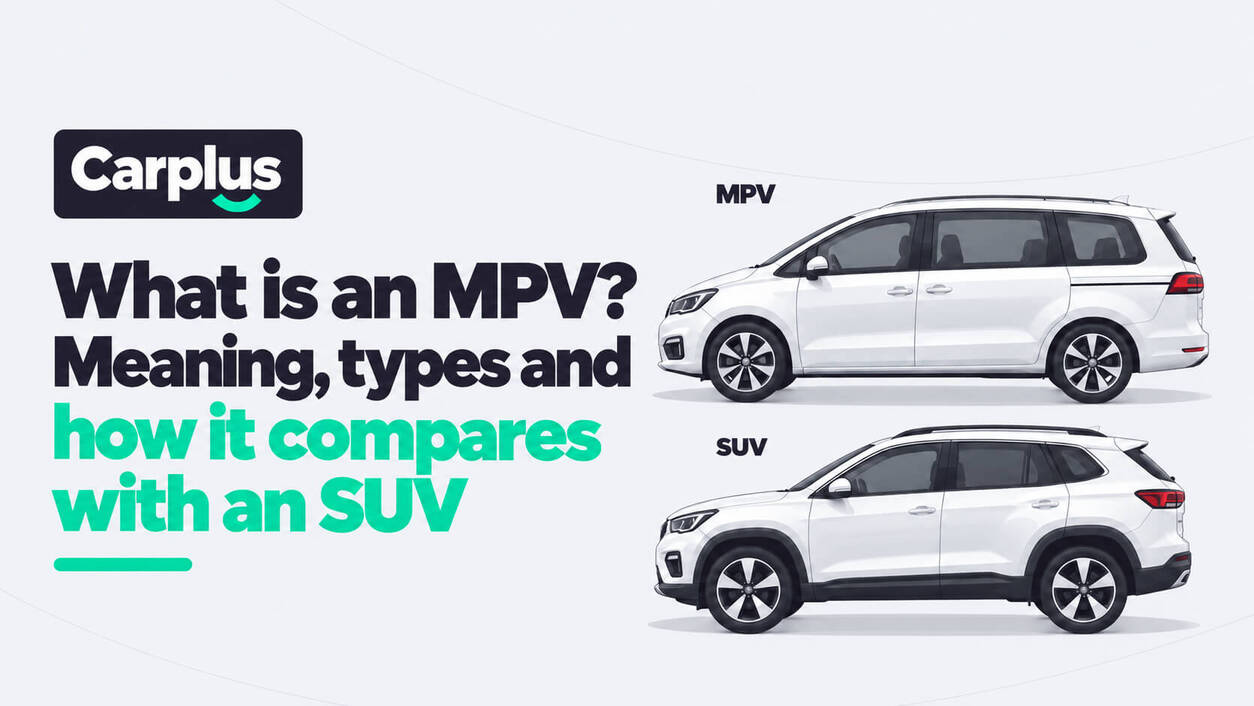
An MPV uses its height for a bigger cabin, while an SUV uses its height to sit further off the ground and look more rugged. That's why an MPV usually fits more people and luggage into the same length of car.
| MPV | SUV | |
|---|---|---|
| Ride height | Similar to a hatchback | Higher off the ground |
| Body shape | Tall, often one-box | Two-box, with the bonnet out in front of the windscreen |
| Seats | Often slide, fold or come out one by one | Usually fold flat, rarely removable |
| Third row (7-seaters) | Common and often roomier | Often tight, best for children |
| Rear doors | Sliding doors are common | Hinged doors |
| Four-wheel drive | Rare | Common option |
| Image and resale value | Less fashionable, can lose value faster | Strong demand |
| Price for the same space | Usually lower | Usually higher |
An SUV still wins on ride height and on the choice of four-wheel-drive versions. For a fuller side-by-side, see our guide to MPVs vs SUVs.
Crossovers sit between hatchbacks and SUVs, and they've largely replaced compact MPVs in showrooms with a sportier look but less cabin flexibility.
MPV vs estate, van and minibus
An MPV is built around passengers first and luggage second. An estate car puts luggage first, and a van is built for goods.
| Built mainly for | Usual seats | Main trade-off | |
|---|---|---|---|
| MPV | Passengers, then luggage | 5 to 9 | Less sleek; larger models feel bulky to drive |
| Estate car | Luggage behind 5 seats | 5 | Lower roof, so less headroom and harder access |
| Van | Goods | 2 to 3 (crew vans up to 6) | Basic cabin, few or no rear seats |
| Minibus | Groups | 9 or more passenger seats | Usually needs an extra licence |
If boot space matters more to you than extra seats, an estate car could be the better fit. Our list of the best used hybrid estate cars is a good place to start.
Are MPVs good family cars?
Yes, MPVs make good family cars if you have 3 or more children or often carry extra passengers. An MPV helps a family in 4 ways:
- Three child seats side by side: 3 Isofix points across the second row let you fit 3 child seats next to each other. Few hatchbacks or SUVs manage that.
- Easy access: raised seats, wide openings and sliding doors make lifting children in easier, especially in tight car parks.
- Space you can rearrange: fold or remove single seats to carry a bike or buggy and still take 3 or more passengers.
- Long-trip extras: many MPVs have fold-out tables, extra storage and rear charging points.
Compact 7-seat MPVs come with a catch. With every seat in use, their boot is small, and the third row is really only for children. If 3 child seats in a row is the main thing you need, we've picked out the best cars for 3 child seats.
Sliding doors and low step-in heights also make MPVs a common choice for drivers and passengers with limited mobility (see our cars that fit a wheelchair in the boot).
Electric and luxury MPVs
Electric MPVs
Most electric MPVs are van-based, including the Volkswagen ID. Buzz, Citroën ë-Berlingo, Peugeot e-Rifter and Mercedes-Benz EQV. If you're open to other body types, too, our best used electric cars list covers the wider market.
Luxury MPVs
Luxury MPVs have fewer seats, with more space around each one and often individual chairs that recline or swivel. You'll find luxury MPVs such as the Lexus LM and high-end Mercedes-Benz V-Class working as chauffeur cars and executive shuttles.
Pros and cons of an MPV
An MPV gives you more usable space than almost any other car of the same length. The trade-off is mostly image and driving appeal.
Advantages of an MPV
- More cabin space and more seats than most cars of a similar length
- Rear seats you can rearrange one by one
- Easy to get in and out of, especially with sliding doors
- Large windows and a good view out
- Usually cheaper than an SUV with the same number of seats
Disadvantages of an MPV
- Uses more fuel or electricity than an equivalent hatchback, because of its extra weight and boxy shape
- Fewer new models to choose from, as carmakers have switched to SUVs
- Less fashionable, so values can fall faster (which helps if you're buying used)
- Larger models can feel bulky in town and on twisty roads
- Third-row seats in compact 7-seaters are cramped for adults
For most families who regularly fill more than 5 seats, we'd choose an MPV over a 7-seat SUV. Want a higher ride or four-wheel drive instead? Then a 7-seat SUV makes more sense, and we've rounded up the best 7-seater SUVs in the UK.
Final words
An MPV is a practical choice when you regularly carry 5 to 9 people and their luggage, as long as you can live with a less fashionable image.
If you're shortlisting an MPV, start with how many seats you really use. A car-based 7-seater such as the Dacia Jogger or Volkswagen Touran drives most like a normal car, while a van-based MPV such as the Citroën Berlingo gives you more space and sliding doors. Sit in the third row before you commit, because in compact 7-seaters it's often only big enough for children.
And because MPVs can lose value faster than SUVs, a used MPV can stretch your budget further.
Table of Contents