




Two used cars with the same price tag today can be worth very different amounts when you come to sell them. The model you pick matters most: on a £15,000 car, a Volvo XC40 loses about £1,960 less over 3 years than a rival Range Rover Evoque. Fuel, brand and size matter too, while an SUV body and a premium badge don't.
That's what the asking prices of 41,284 used cars on two large UK dealer websites show. We always compare like with like: each car against others of the same model and specification.
Key findings
- The model matters most. On a £15,000 car, a Volvo XC40 loses about £1,960 less over 3 years than a rival Range Rover Evoque. Electric or petrol, the brand and the size come next.
- SUV or hatchback, premium or not: no difference. For cars of the same size, neither changes how fast a car loses value.
- Electric and plug-in versions lose more. Against the petrol version of the same model, they lose £1,100–£1,900 more over 3 years. Hybrid, mild hybrid and diesel versions stay close to petrol.
- Buy a used electric car at 3 or older. From that age it loses about the same as any used car. Bought at 1 year old, it loses £1,620 more.
What matters most when you choose a used car
The model you choose changes what you lose more than anything else. On a £15,000 car kept for 3 years, a Volvo XC40 loses about £1,960 less than a Range Rover Evoque, a rival premium compact SUV. The XC40 loses 7.5% a year, the Evoque 12.8%.
The other choices come close behind, but each one counts for less on its own:
- Fuel: the petrol version of a model saves about £1,860 over the electric one (8.3% against 13.5% a year, in the first 5 years).
- Brand: a Toyota saves about £1,720 over a Land Rover (8.0% against 12.7% a year). Part 1 has the full brand list.
- Size: a city car saves about £1,160 over an executive car (8.6% against 11.8% a year).
So start with the model. Then pick the fuel and size, and treat the body style and badge as a matter of taste.
The used car models that hold their value best and worst
The used car models that hold their value best are mostly small petrol crossovers and hatchbacks, led by the SEAT Arona at 6.0% a year. The ones that lose value fastest are mostly premium SUVs and saloons from Land Rover, BMW and Mercedes. We only ranked models with at least 150 cars for sale, so you'll find plenty of each.
Show Image
12 used cars that hold their value best
| Model | Value lost a year |
|---|---|
| SEAT Arona | 6.0% |
| Volkswagen Taigo | 6.1% |
| Fiat 500 | 6.9% |
| Volkswagen T-Cross | 7.1% |
| Nissan Juke | 7.1% |
| Volvo XC40 | 7.5% |
| Mercedes CLA | 7.5% |
| Toyota Yaris | 7.5% |
| Toyota C-HR | 7.5% |
| Suzuki Vitara | 7.7% |
| Volkswagen Polo | 7.7% |
| SEAT Ateca | 7.8% |
12 used cars that lose their value fastest
| Model | Value lost a year | One version of the same car |
|---|---|---|
| Land Rover Discovery Sport | 14.0% | |
| Jaguar F-Pace | 13.4% | 9.6% (new generation on sale) |
| Range Rover Evoque | 12.8% | |
| Mercedes E-Class | 12.8% | |
| BMW 4 Series | 12.7% | |
| BMW X1 | 12.1% | 8.6% (new generation on sale) |
| Vauxhall Grandland | 11.9% | 8.4% (new generation on sale) |
| Dacia Duster | 11.9% | 7.9% (new generation on sale) |
| BMW 5 Series | 11.9% | |
| Hyundai Tucson | 11.6% | 6.2% (new generation on sale) |
| Mercedes C-Class | 11.6% | |
| BMW X3 | 11.6% |
Why some fast losers can still be a good buy
Five models on the fast list mostly reflect a new generation (a redesigned version of the model) going on sale. When it arrives, the old one steps down in price once, and our figures count that step as ageing.
A car you already own doesn't take that step every year. Compared version by version, a Hyundai Tucson loses just 6.2% a year rather than 11.6%, and a Dacia Duster 7.9% rather than 11.9%. Once the new generation is out, the old one may be a better buy than its place on the list suggests.
What fast-depreciating models have in common
The strongest link we found is fuel: models that lose value fast are more often diesels. They also tend to have bigger engines, cover more miles a year and come with an automatic gearbox more often.
A model's price on its own and how popular it is make little difference. So an expensive or popular car doesn't automatically lose value faster. These are links in the data, though, not proof that diesel or a big engine causes the loss.
How much picking the right model can save you
Picking a model that holds its value can save you thousands of pounds. Kept for 3 years, a £15,000 car losing 6% a year, like a SEAT Arona, is still worth about £12,460. At 14% a year, like a Land Rover Discovery Sport, it's worth about £9,540.
That's roughly £2,900 back in your pocket for choosing well.
How car size affects how fast a car loses value
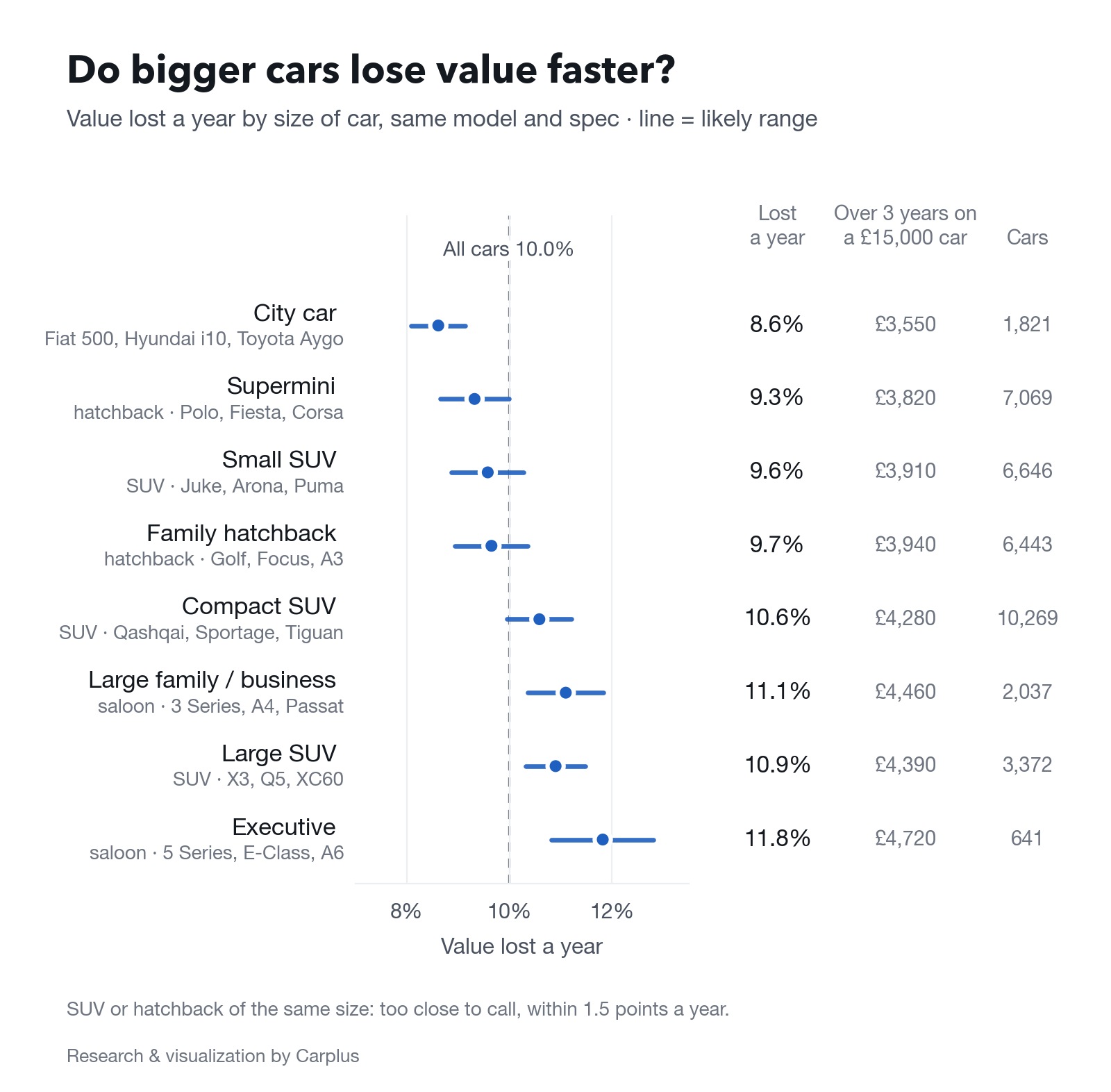
The bigger the car, the faster it loses value. A city car loses 8.6% a year and an executive car 11.8%, and each step up in size adds about 0.7% a year. On a £15,000 car kept for 3 years, that's £3,550 lost on a city car against £4,720 on an executive car.
Do bigger cars lose more value at the same mileage?
Bigger cars lose value faster even at the same mileage, so the gap isn't just down to bigger cars doing more miles. At equal mileage, a city car loses 6.3% a year and an executive car still loses 9.0%.
Do SUVs lose value faster than hatchbacks of the same size?
SUVs lose value at the same pace as hatchbacks of the same size, so you don't need to avoid an SUV to protect what you'll get back. A small SUV loses 9.6% a year against 9.3% for a supermini. A large SUV loses 10.9%, slightly less than the 11.1% of a large family car.
The widest gap is between a compact SUV, at 10.6%, and a family hatchback, at 9.7%. In every size the gap stays within 1.5% a year, and none is big enough to be sure it's real.
If you've heard that SUVs depreciate faster, that's because the raw figures say so. Cars listed as SUVs lose 10.8% a year, against 9.5% for hatchbacks. But SUVs are bigger on average, and size explains the gap. The listing labels muddy things too: 41% of crossovers are listed as hatchbacks.
Does a premium badge make a car lose value faster?
A premium badge makes no clear difference for cars of the same size. Among large SUVs, premium models may lose about 1.5% a year more than mainstream ones, but even that gap is too small to be sure of.
So pick the size you need, then the model, and let the badge be your choice.
How fuel type affects how fast a car loses value
Electric and plug-in hybrid versions of a model lose clearly more value than the petrol version, while hybrid, mild hybrid and diesel versions stay close to petrol. That's what we found comparing each version with the petrol version of the same model, for cars 1 to 5 years old.
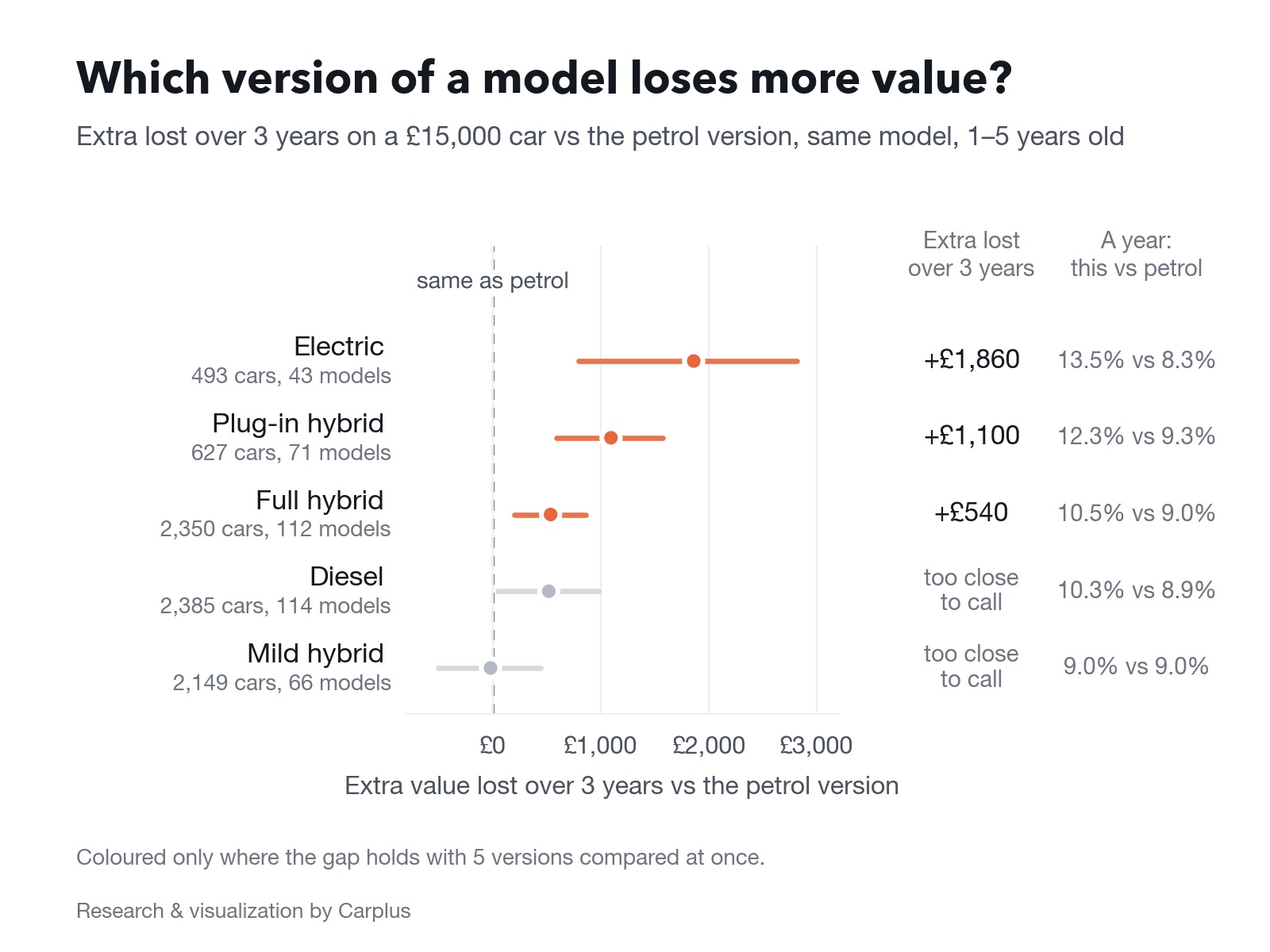
On a £15,000 car kept for 3 years, here's what each version costs you on top of the petrol one:
- Electric: about £1,860 more (13.5% a year against 8.3%). The likely range runs from £800 to £2,820.
- Plug-in hybrid: about £1,100 more (12.3% against 9.3%).
- Full hybrid: about £540 more (10.5% against 9.0%).
- Diesel and mild hybrid: too close to petrol to call.
The electric gap depends on how strictly we match the versions. Comparing exactly the same version, an electric car loses about 3% a year more than petrol, rather than 5%. Either way, the gap is real.
Full, mild or plug-in hybrid: why the type matters
The word "hybrid" on a listing tells you little, because the three kinds lose value at different rates. A full hybrid (HEV) charges its own battery as you drive. A mild hybrid (MHEV) uses a small electric motor to help the petrol engine. A plug-in hybrid (PHEV) has a bigger battery you charge from a socket.
Mild hybrids lose value just like the petrol version, at 9.0% a year. Many listings show them simply as "petrol", so we took the fuel from each car's version name instead. That moved 2,431 hybrids out of the petrol group.
Plug-in hybrids are the costly ones. They lose about £1,100 more than petrol over 3 years, much closer to an electric car than to a full hybrid.
What happens after 5 years?
After 5 years, diesel versions lose a little more than petrol: 12.0% a year against 10.7%, or about £430 over 3 years. Full hybrids, by then, no longer lose more than petrol.
Why compare fuels within the same model?
Comparing all diesels with all electric cars would mislead you, because the cars on sale differ so much. Half the diesels for sale are 7 years or older, while electric and hybrid cars are young. Full hybrids are mostly Toyotas and Hyundais, brands that hold their value anyway.
Comparing each version with the petrol version of the same model takes age, brand and size out of the picture. That's why we use it.
How fast electric cars lose value
Electric cars lose most of their extra value in the first years. Between 1 and 3 years old, an electric car loses 31% of its value, against 21% for the average used car. In practice, a £15,000 one-year-old electric car is worth about £10,350 by its third birthday, while an average car is still worth £11,850.
For one particular version of an electric car, the loss over those 2 years is closer to a quarter.
Why a 3-year-old electric car is the better buy
A 3-year-old electric car loses about the same as any used car, because the steepest drop is already behind it. Bought at 1 year old, a £15,000 electric car loses £5,560 over the next 3 years, £1,620 more than any used car of that age. Bought at 3, it loses £3,710, much like any other car.
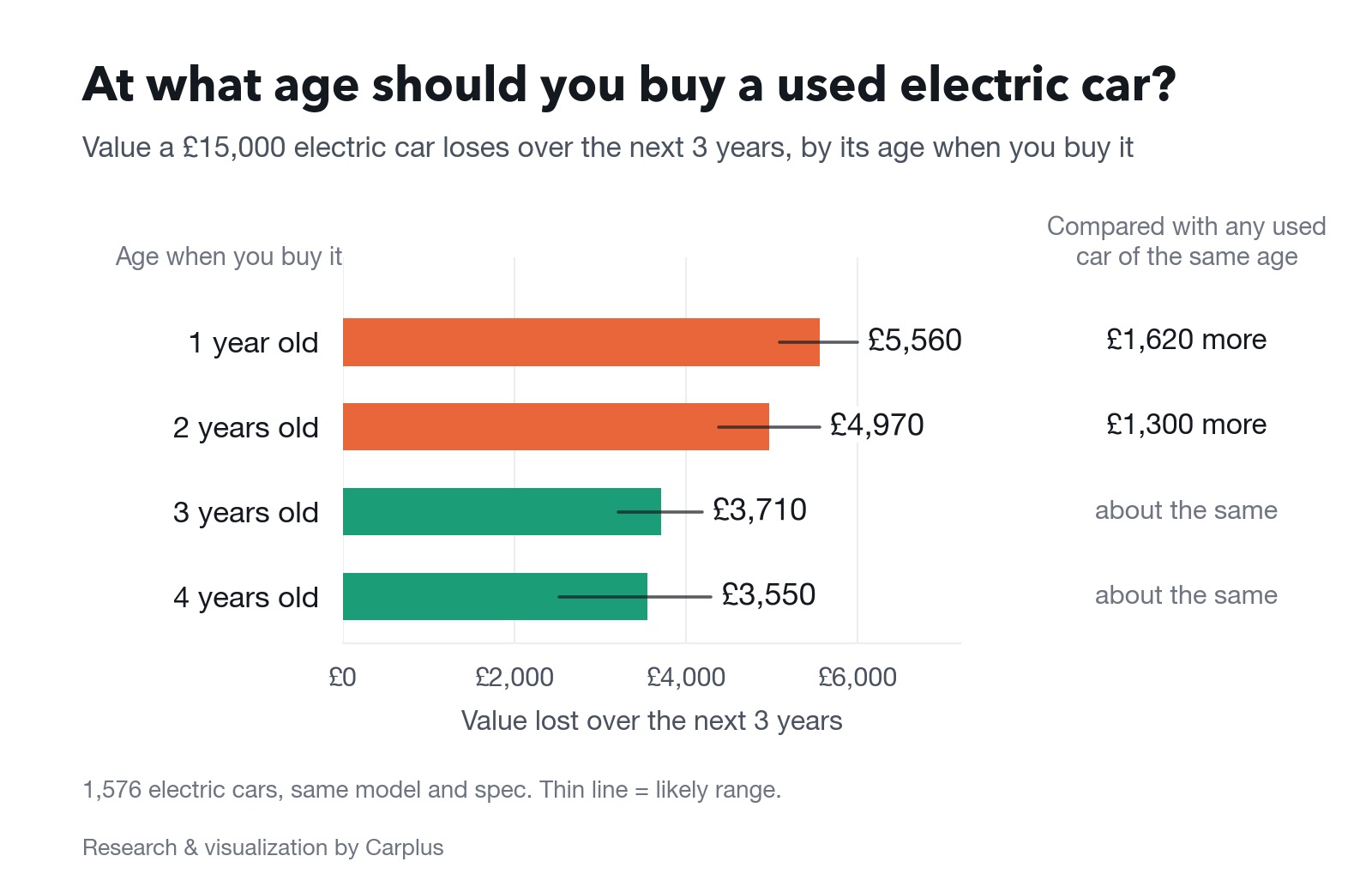
After year 3, electric cars lose value at a normal pace: 8.7% in year 4, 9.7% in year 5, then 8.7% and 7.4% in years 6 and 7. Only 133 electric cars on sale are 6 or older, though, so the later figures are less certain.
Does mileage matter for an electric car's value?
Mileage matters far less than age for an electric car. Every 10,000 miles takes just 2.1% off its price, against 4.7% for the average car. So a few extra miles on an electric car's clock cost you less than you might think.
Battery size works in your favour too. An extra 10 kWh of battery (a measure of how much energy it stores) adds 6% to 11% to the price of the same model. That premium doesn't fade as the car gets older, so you keep more of it when you sell.
Which electric cars hold their value best?
The Mercedes EQC holds its value best of the electric cars we looked at, losing 7.9% a year, followed by the Vauxhall Mokka Electric at 8.3%. The Hyundai Kona Electric loses the most, at 15.8%, followed by the Audi Q4 e-tron at 14.2%. The average electric car loses 11.9% a year.
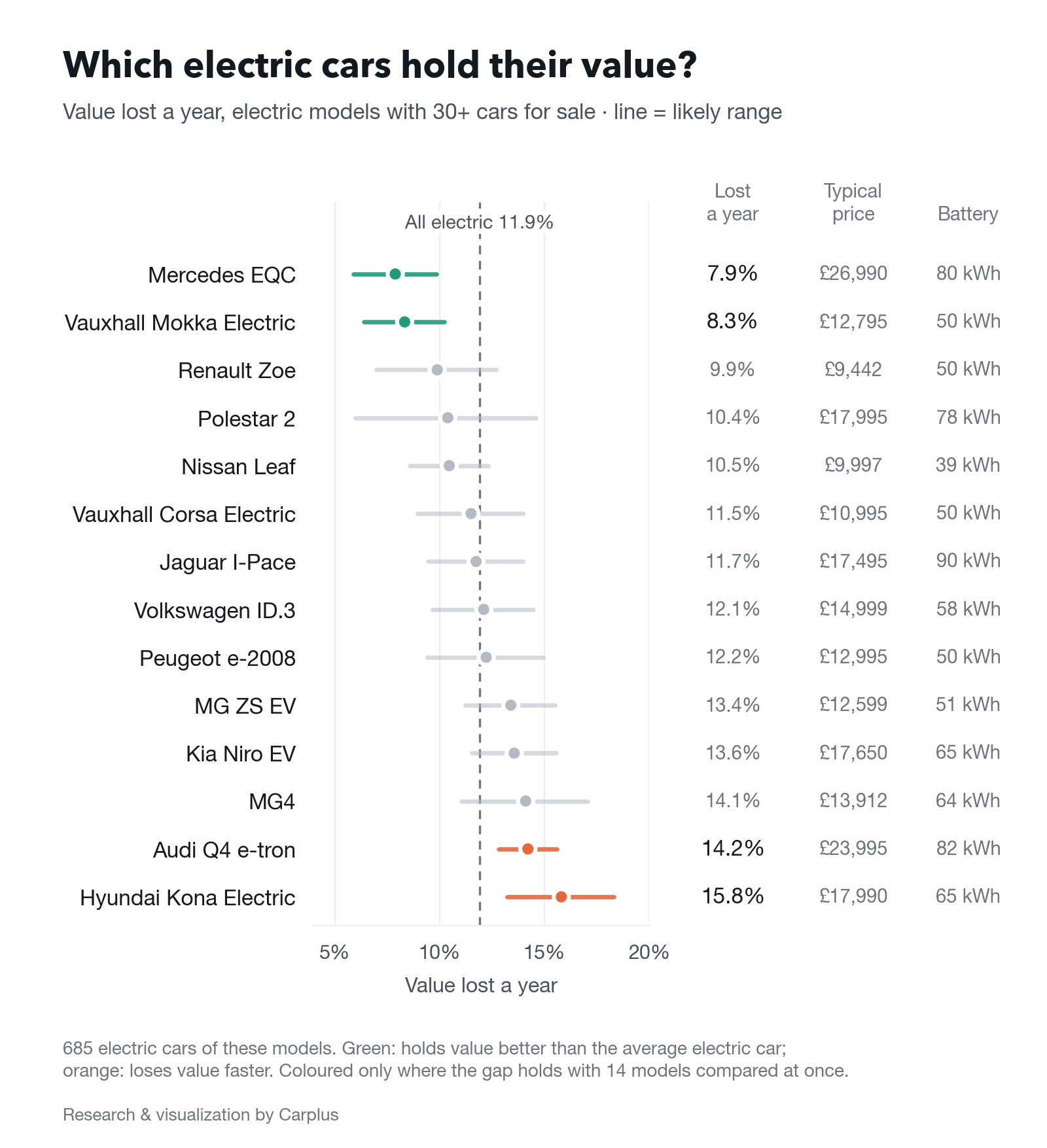
The other ten models, from the Renault Zoe (9.9%) to the MG4 (14.1%), sit too close to the average to call. We only included models with at least 30 cars for sale.
How to choose a used car that holds its value
A small petrol or full hybrid crossover or hatchback, picked model by model, will lose you the least. The SEAT Arona, Volkswagen Polo, Toyota Yaris and Fiat 500, for example, all lose less than 8% a year. Five rules follow from our data:
- Start with the model, not the badge or the body. On a £15,000 car, a Volvo XC40 saves about £1,960 over 3 years against a rival Range Rover Evoque. An SUV body or a premium badge of the same size changes nothing you can count on.
- Smaller costs less to own. A city car loses about £1,160 less over 3 years than an executive car.
- Pick the version with your eyes open. The electric or plug-in version of a model loses £1,100 to £1,900 more over 3 years than the petrol one. A hybrid, mild hybrid or diesel stays close to petrol.
- Buying electric? Buy at 3 or older. A £15,000 electric car bought at 1 loses £5,560 over 3 years. Bought at 3, it loses £3,710.
- Don't write off a model with a new generation on sale. It has already taken its one-off step down in price, and one particular car then loses value at a normal pace.
The bottom line
The car that costs you least isn't the cheapest one on the forecourt. It's the one that holds its value, and the model decides that far more than the badge, the body style or the price tag.
So shortlist by model first, check the version and its fuel, and give an electric car a couple of years to take its big drop before you buy.
Depreciation is only one part of what a car costs you, though. In Part 3, we look at what's worth paying for, from the gearbox to trim and options. We also look at why nearly twice as many 2023 cars for sale haven't made them cheaper.
Found the right car? Check your finance options – we use a soft search, so there's no impact on your credit score.
Table of Contents