




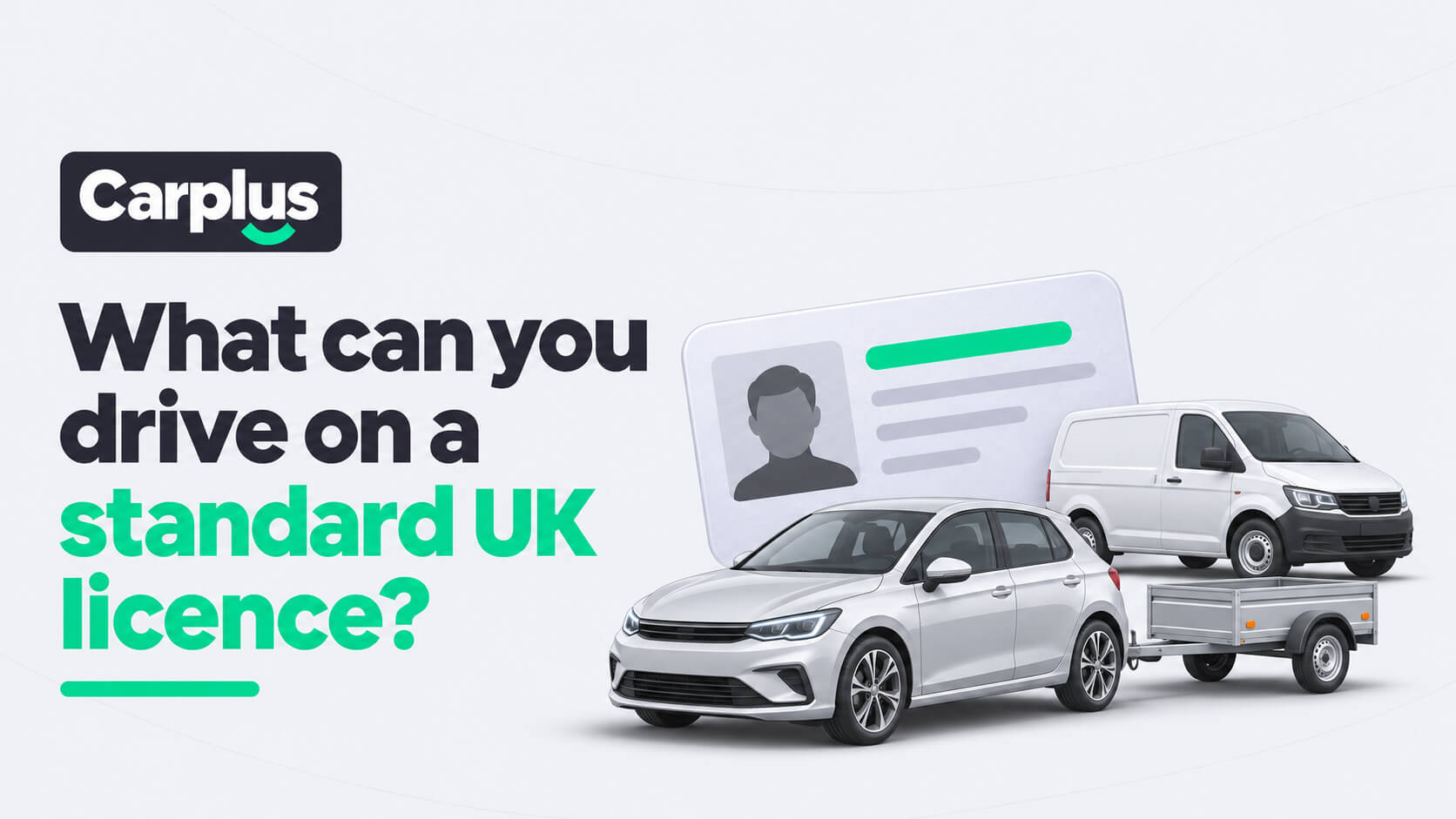
What you can drive on a standard UK licence is set by category B, which covers cars and vans up to 3,500kg maximum authorised mass (MAM) with up to eight passenger seats. You can also tow a trailer up to 750kg, and since June 2025 zero-emission vehicles can weigh up to 4,250kg MAM in Great Britain. Anything heavier needs C1, C or D, and bigger trailers need BE (car and trailer), which most drivers who passed from 1997 already have.
What is the biggest vehicle you can drive on a car licence?
The biggest petrol or diesel vehicle you can drive on a car licence has a maximum weight of 3,500kg MAM and up to eight passenger seats. Hybrids count as petrol or diesel here. Electric and hydrogen vehicles get a higher limit of 4,250kg MAM, because batteries and fuel cells add weight that a diesel engine doesn't.
| Petrol, diesel or hybrid | Zero-emission (electric or hydrogen) | |
|---|---|---|
| Maximum vehicle weight (MAM) | 3,500kg | 4,250kg |
| Passenger seats | Up to 8 | Up to 8 |
| Where it applies | Whole UK | Great Britain, since 10 June 2025 |
| Towing | Trailer up to 750kg, or more with BE | Combined vehicle and trailer up to 7,000kg |
So a 3.5-tonne diesel van is fine on a car licence, but a 3.9-tonne diesel van isn't, even if it looks almost the same. A 4.25-tonne electric van with similar dimensions is allowed. The fuel type changes the limit, not the van's size.
Zero-emission minibuses up to 4,250kg can also be driven on a category B licence. But you'll need to meet the extra conditions that already apply to minibuses on a car licence, such as being 21 or over.
Large goods vehicles over 3,500kg need C1 or C.
A car licence doesn't include category D either. You'd need it to drive any bus with more than eight passenger seats, or D1 for minibuses with up to 16. Drivers who passed before 1997 usually hold D1 already, but only for unpaid use.
Vans and motorhomes
Vans and motorhomes up to 3,500kg MAM are fine on a car licence, but many sit right on that line, so check the exact figure before you drive one. Hiring a Luton van for a house move? Many weigh exactly 3,500kg, so look at the plate before you set off.
Pick-ups and crew vans follow the same rule, as the Carplus guide to driving a van on a car licence explains.
A larger coachbuilt motorhome or a horsebox can easily be 4,000kg or more. That puts it in category C1. Campervans within the category B limits can be spread over monthly payments with motorhome finance for campervans and caravans.
Buying rather than hiring? Carplus compares 15+ lenders, and we can help with van finance on a provisional licence as well as a full one.
What MAM means and where to find it
Maximum authorised mass (MAM) is the most a vehicle is allowed to weigh when fully loaded, including passengers, fuel and cargo. It isn't the payload, and it isn't what the vehicle weighs empty (its unladen weight).
You'll usually find the MAM on the vehicle's plate or sticker, often inside the driver's door frame or under the bonnet, and in the V5C logbook. Go by that figure rather than the model name. A '3.5-tonne van' and a '3.5-tonne payload' are very different things.
Can I tow a trailer on a standard car licence?
A standard car driving licence lets you tow a trailer up to 750kg MAM behind a vehicle up to 3,500kg MAM. Together, that's 4,250kg. Category B also lets you tow a heavier trailer, as long as the vehicle and trailer together are no more than 3,500kg MAM.
Category BE allows vehicle and trailer combinations beyond the category B limits, with a trailer up to 3,500kg MAM. Most drivers in Great Britain already have it.
Since 16 December 2021, anyone who passed their car test on or after 1 January 1997 can tow trailers up to 3,500kg MAM without a separate test. So most caravans need no extra licence. DVLA added BE to driving licence records automatically, and it shows on your photocard the next time you renew it.
Passed before 1997? You can usually drive vehicle and trailer combinations up to 8,250kg MAM, because older licences already had wider rights.
Two limits still apply whatever your licence says. The trailer must stay within your car's own towing limit, which is in the handbook and sometimes on the vehicle plate. And the trailer itself must not exceed 3,500kg MAM, which is its weight when fully loaded.
Not every electric car is rated to tow, so check that before you decide whether to buy an electric car.
| Your licence | Vehicle limit (MAM) | Trailer limit (MAM) | Combined limit |
|---|---|---|---|
| Category B only | 3,500kg (4,250kg zero-emission) | 750kg, or more if the combination is no more than 3,500kg | Up to 4,250kg (3,500kg with a trailer over 750kg) |
| B96 | 3,500kg | Over 750kg | Over 3,500kg, up to 4,250kg |
| BE (automatic since 16 December 2021 for test passes from 1 January 1997, GB) | 3,500kg | Up to 3,500kg | Up to 7,000kg |
| Zero-emission vehicle on B (GB) | 4,250kg | Up to 3,500kg | Up to 7,000kg |
| Passed before 1 January 1997 | 3,500kg | Within the combined limit | Usually up to 8,250kg |
B96 allows combinations between 3.5 and 4.25 tonnes. But most drivers who passed from 1997 now have BE. So few need B96 now.
These towing rules apply in England, Scotland and Wales. If you hold a Northern Ireland licence, check the rules on nidirect, as they differ.
Worked examples
Say you're towing with a car licence passed after 1997. Here's how five common set-ups work out.
- 3,500kg van with a 750kg trailer: 4,250kg in total. A category B licence allows this, whenever you passed.
- 1,600kg hatchback with a 1,200kg trailer: the trailer is over 750kg, but the pair come to 2,800kg, so category B alone is enough.
- 2,200kg SUV with a 1,800kg caravan: 4,000kg in total, so you need BE. You already have it if you live in Great Britain. Just keep 1,800kg within the SUV's towing limit.
- 4,250kg electric van with a 2,750kg trailer: 7,000kg in total. That's the most a zero-emission vehicle and its trailer can weigh together on a car licence.
- 3,900kg diesel van with no trailer: over 3,500kg, so you'd need C1, even without towing anything.
These are illustrations, so check the MAM figures for your own vehicle and trailer.
What else can you drive on a car licence?
A car licence also lets you drive agricultural tractors (category F) and, once you've done compulsory basic training (CBT), mopeds up to 50cc. A few other vehicles come with it too:
- Ride-on mowers: category K takes in mowing machines and pedestrian-controlled vehicles.
- Mopeds without CBT: if you passed your car test before 1 February 2001, you don't need CBT to ride a moped.
- Motor tricycles: if you're over 21, you can drive motor tricycles with a power output above 15kW.
What is a category B driving licence?
A category B driving licence is the standard UK car licence, which you get by passing the theory test and the practical driving test. Until then you drive on a provisional licence, and some lenders offer car finance with a provisional licence. The 'B' appears in section 9 on the front of your photocard and in the table on the back, with the date the entitlement started.
Category B lets you drive vehicles up to 3,500kg MAM (4,250kg if zero-emission, in Great Britain) with up to eight passenger seats, plus a trailer up to 750kg. The minimum age for a car licence is usually 17. Some people can start earlier, such as those who get the higher-rate mobility component of Personal Independence Payment (PIP).
Automatic and manual cars
A 'B auto' licence is a category B licence restricted to vehicles with automatic transmission, shown as code 78 on your licence. You'll get it if you pass your test in an automatic. A manual pass covers both, which is a big part of choosing between a manual or automatic car.
What is a B1 licence?
A B1 licence covers light four-wheeled vehicles up to 400kg unladen, or 550kg if they're designed for goods. Quadricycles and quad bikes are the usual examples. It's a separate entitlement from category B, so a B1 holder can't drive a standard car.
Category B1 shows on many older car licences. Why so rare now? The B1 test is only open to drivers registered as disabled.
If you have a full car licence, you don't need B1 to drive a road-legal quad bike.
Looking for a van or a larger car that fits your licence? Check your van finance options with Carplus. We use a soft search, so there's no impact on your credit score at this stage.
What licence do I need for a bigger vehicle?
Vehicles over 3,500kg MAM need category C1 or C, and anything with more than eight passenger seats needs D1 or D. If you hold a full category B driving licence, you may be able to apply for provisional entitlement in a higher category through DVLA. That's the first step.
| Category | What it covers | Trailer |
|---|---|---|
| Provisional entitlement | Lets a full category B holder learn to drive a larger vehicle | n/a |
| C1 | Vehicles between 3,500kg and 7,500kg MAM, such as larger motorhomes, horseboxes and ambulances | Up to 750kg |
| C1E | A C1 vehicle with a trailer over 750kg | Combination up to 12,000kg |
| C | Vehicles over 3,500kg MAM, in practice those above the 7,500kg C1 range | Up to 750kg |
| CE | A category C vehicle with a trailer over 750kg | Over 750kg |
| D1 | Minibuses no longer than 8 metres, with up to 16 passenger seats | Up to 750kg |
| D1E | A D1 minibus with a trailer over 750kg | Combination up to 12,000kg |
| D | Any bus or coach with more than eight passenger seats | Up to 750kg |
| DE | A category D bus with a trailer over 750kg | Over 750kg |
Category C1 takes in vehicles between 3,500kg and 7,500kg MAM, and category C anything heavier. Both allow a trailer up to 750kg. Category D1 is for minibuses no longer than 8 metres, with up to 16 passenger seats, while category D includes any bus with more than eight.
The bigger categories usually involve a higher medical standard, a separate theory test and a practical test. Professional lorry and bus drivers also need a Driver Certificate of Professional Competence (CPC).
Drivers who passed their car test before 1 January 1997 usually already hold C1, C1E up to 8,250kg, D1 and D1E. So an older licence can cover a 7.5-tonne lorry, while a newer one needs a C1 test. The minibus categories come with a 'not for hire or reward' condition.
Can I ride a motorbike or moped on a car licence?
A car licence lets you ride a moped once you've done CBT, but a bigger motorbike needs category A1, A2 or A. Category AM is for mopeds up to 28mph, A1 for motorbikes up to 125cc and 11kW, and A2 for bikes up to 35kW. A full A licence allows anything more powerful.
With a valid CBT certificate, you can also ride a motorbike up to 125cc and 11kW on L plates.
After holding an A2 licence for two years, a rider can take a further practical test (Modules 1 and 2) on a large motorcycle. Passing it gives an unrestricted A licence without another theory test. Riders aged 24 or over can go straight to a full A licence through direct access.
How to check what your licence covers
The quickest way to see what your own driving licence covers is to look at the driving licence categories on the back of your photocard. You can also view your record online with DVLA's 'View or share your driving licence information' service. It shows every category, the dates they started and any restriction codes.
Carplus also has a guide on whether paper driving licences are still valid, if you still hold one.
Final words
A standard car licence covers more than most drivers expect, from vans and campervans to tractors and, after CBT, mopeds. Weight is what catches people out, not size. A diesel van over 3,500kg needs C1, even if it looks like one you could drive.
So before you hire a van, buy a motorhome or hitch up a caravan, check the MAM on the vehicle's plate and the trailer's. If both are within the category B limits, you're free to get behind the wheel on your car licence.
Table of Contents