





Used electric cars have been one of the most unpredictable parts of the UK car market in recent years. Prices fell sharply, buyers questioned battery life and charging costs, and many drivers held off to see whether EVs would become better value before committing.
That wait may now be over.
The latest market data suggests 2026 is shaping up to be a genuine turning point for used EV buyers, not because prices are in freefall, but precisely because they have stopped falling. In this Carplus research, we examine recent figures from Auto Trader and SMMT, compare demand and supply trends, look at what price stability means for finance customers, and walk through exactly what you should check before buying a used electric car.
Carplus is a UK car finance broker. This research is designed to help buyers understand the used EV market and make informed decisions about car finance.
How to Read This Research
This article covers a lot of ground: market data, model comparisons, finance mechanics, buying practicalities. We get it. You don't need to read it front t o back:
- Just want the big picture? Start with the first two sections and jump to the final verdict.
- Comparing specific models? Go straight to the tables in the desirability and risk sections.
- Finance is your main question? The payment comparison section stands on its own.
- Ready to buy and just need a checklist? Skip to the pre-purchase checklist at the end.
One number to keep in mind as you read: £72. That is the price gap between a 3–5-year-old used EV and a comparable petrol car in May 2026. Almost everything in this article connects back to that number and what it means for buyers who have been waiting on the sidelines.
Have used EV prices finally stopped falling?
Yes and that matters more than it might first seem.
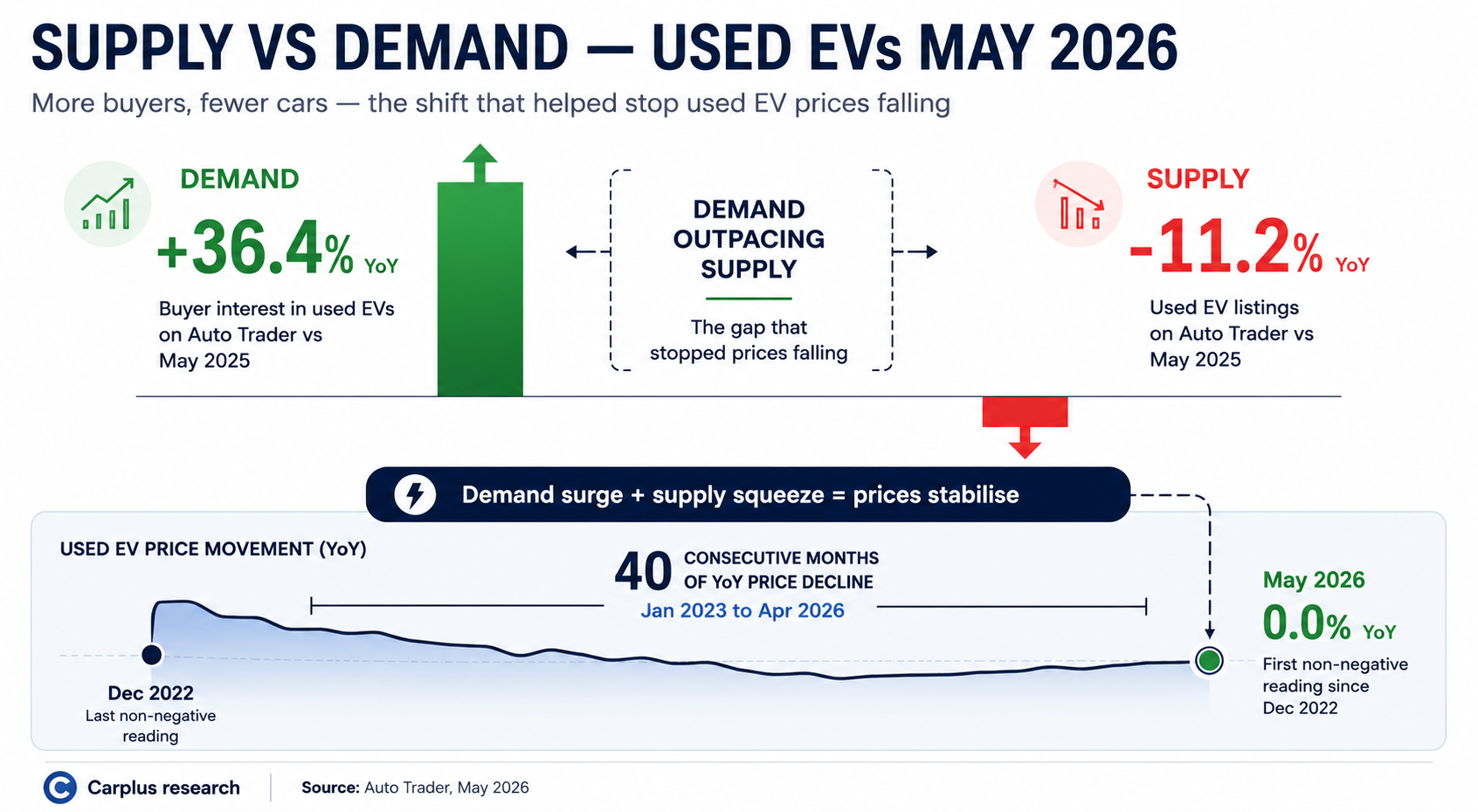
Auto Trader reported that year-on-year used EV pricing reached 0.0% in May 2026 — the first time annual EV pricing had been non-negative since December 2022, ending 40 consecutive months of decline.
That's a significant shift in psychology as much as economics. When prices are falling every month, the rational move is to wait — the same car will be cheaper next month. When prices flatten, that logic breaks down. The question becomes whether the right car, at the right monthly payment, is available now.
What has driven this change is a stronger balance between demand and supply. Used EV demand rose 36.4% year on year in May 2026, while supply fell 11.2%. More buyers are actively looking, but there are fewer available cars competing for their attention. The result is a market that is beginning to behave like any other: demand outpacing supply, prices stabilising, and the best stock selling quickly.
This does not mean every used EV has reached the bottom. The market is stabilising overall, but individual models can still move very differently depending on brand demand, battery range, age, mileage, insurance cost, and charging practicality. The stabilisation is real, but it is not uniform.
What the transaction data actually shows
The price data tells one story; the sales volumes tell the same story from a different angle.
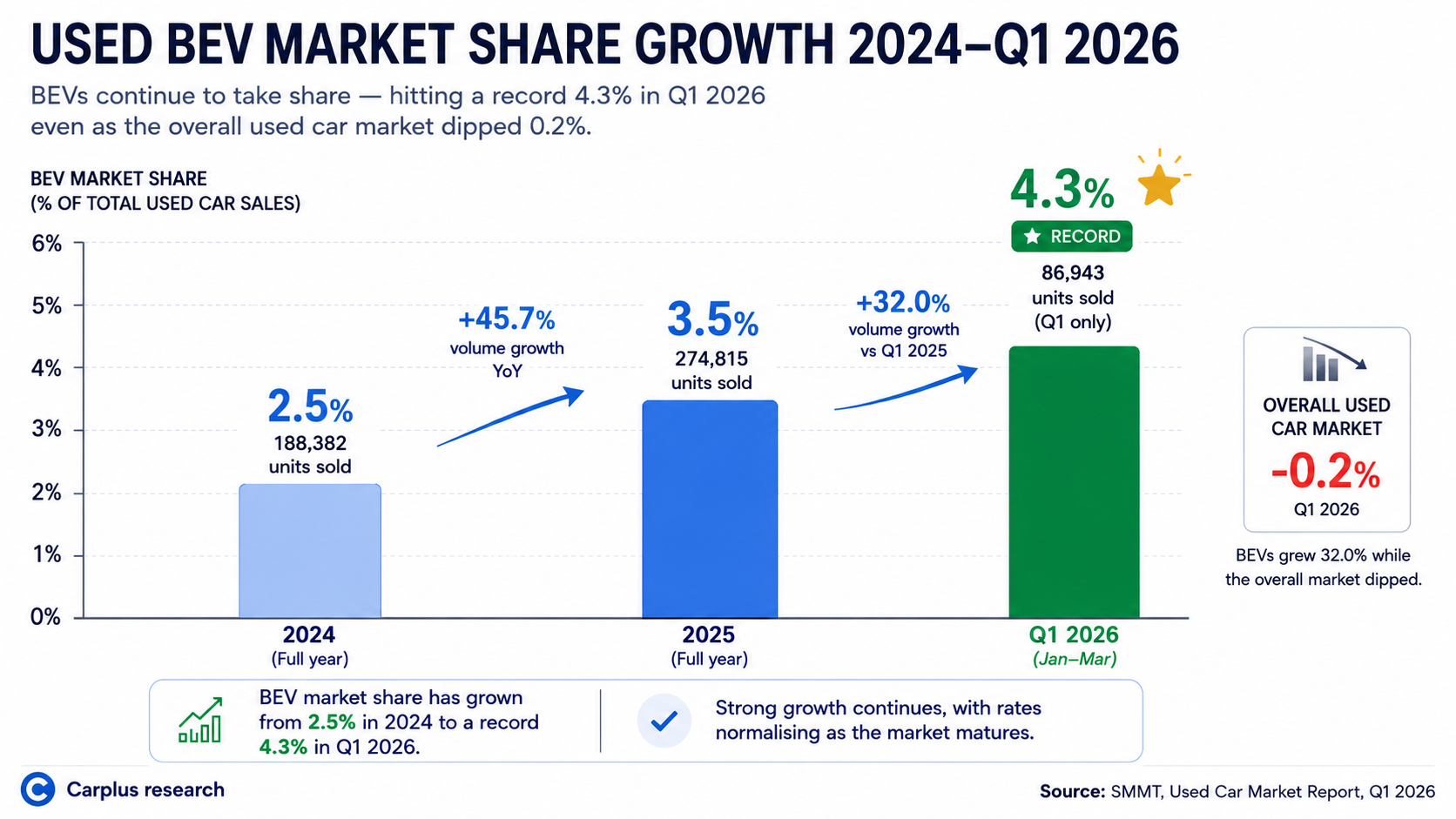
In Q1 2026, SMMT reported that used battery electric vehicle (BEV) transactions rose by 32.0% to 86,943 cars — a new record — giving BEVs a record 4.3% share of the UK used car market, or roughly one in every 23 used car purchases.
Importantly, this happened while the wider used car market was not growing. Total UK used car transactions dipped 0.2% in Q1 2026 to just over 2 million units. Used EVs are not being carried upward by a booming second-hand market — they are actively taking a bigger share of buyer decisions.
This Q1 performance is not a one-off. In 2025, used BEV transactions rose 45.7% to 274,815 cars, pushing BEV market share to 3.5%, up from 2.5% in 2024. Q1 2026 therefore looks less like a spike and more like the continuation of a multi-year trend gathering pace.
For buyers, this matters because demand affects timing. If the best-priced used EVs are now selling in under three weeks and stock is tightening, waiting does not always lead to a cheaper or better car. It may mean fewer options, less room to negotiate, and higher monthly payments if prices continue to hold.
Why are used EVs selling faster than petrol and diesel cars?
The clearest evidence that buyer confidence has genuinely shifted is not in the price data — it is in how fast cars are actually leaving forecourts.
In May 2026, AutoTrader reported that used electric cars sold in an average of 24 days, compared with 29 days for petrol and 32 days for diesel. That is a meaningful gap, and it is the first time EVs have consistently outsold both fuel types on speed.
The fastest-selling models in May reinforce this — and it is worth noting the full picture includes both electric and hybrid vehicles. High fuel prices are driving buyers toward anything with lower running costs, not just pure EVs.
| Model | Fuel type | Avg. days to sell |
|---|---|---|
| MG ZS | Petrol hybrid | 10 |
| Polestar 2 | Electric | 15 |
| Tesla Model 3 | Electric | 17 |
| Kia Niro EV | Electric | 18 |
| Tesla Model Y | Electric | 19 |
| Vauxhall Mokka Electric | Electric | 20 |
| Average used petrol car | Petrol | 29 |
| Average used diesel car | Diesel | 32 |
Source: Auto Trader, May 2026
Nine of the top 10 fastest-selling used cars in May were electric or hybrid. The fastest of all was the petrol hybrid MG ZS at just 10 days — a useful reminder that the appetite for lower running costs is broader than EVs alone, even if pure electric cars dominate the liquidity story.
Speed of sale matters for a practical reason: it signals that these cars can be sold again at a realistic market price without heavy discounting. For buyers using car finance, a vehicle with strong retail demand is generally less exposed to sharp short-term depreciation than one sitting unsold for six weeks.
Are 3-5-year-old EVs the sweet spot?
For most buyers, the strongest value in the used EV market right now sits in the 3-to-5-year-old bracket and the data makes a compelling case.
These cars are old enough to have absorbed most of their early depreciation, but new enough to offer modern range, faster charging speeds, current safety technology, and in many cases remaining battery warranty.
The 3–5-year-old segment attracted 48% of all used EV enquiries on Auto Trader in May 2026. Cars in this bracket were selling in an average of 21 days, 7 days faster than other cars in the same age band (28 days) and almost ten days ahead of the wider used car market average (30 days).
The price comparison with equivalent petrol cars is where the real story lies:
| Vehicle type | Average asking price (3–5 years old) |
|---|---|
| Used EV | £19,022 |
| Equivalent used petrol | £18,950 |
| Difference | £72 |
Source: Auto Trader, May 2026
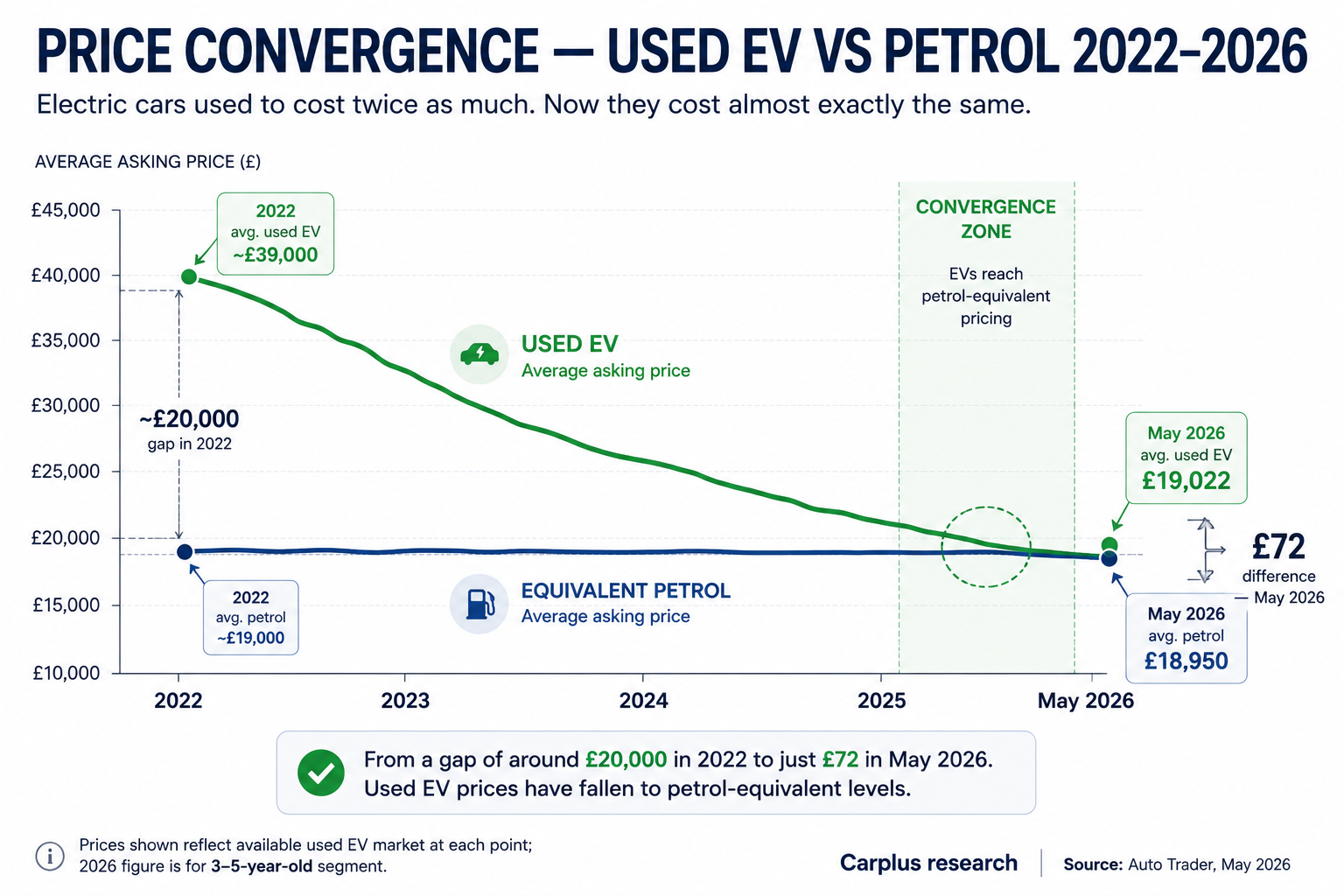
A gap of £72 between an electric car and its petrol equivalent is essentially nothing at the point of purchase. The financial argument has shifted: the question is no longer whether you can afford the electric version, but whether the EV fits your lifestyle and driving habits well enough to justify the switch.
This age band also reduces one of the biggest worries buyers have about used EVs. Many manufacturer battery warranties run to eight years or 100,000 miles, meaning a well-maintained three- to five-year-old car may still carry several years of cover. More fleet vehicles, company cars, and salary-sacrifice scheme returns are also feeding into this part of the market, giving buyers more choice on mileage, condition, trim, and price.
How do used EV finance payments actually compare with petrol?
The numbers above lead to a logical question: if a 3–5-year-old EV and a petrol equivalent cost virtually the same to buy, what does that mean for monthly finance payments?
The short answer is: very little difference and that is exactly the point.
Using a 48-month HP agreement as an illustration, with a 10% deposit and a representative 10.9% APR (your actual rate will depend on your credit profile, lender, and vehicle):
| Used EV | Used petrol | |
|---|---|---|
| Purchase price | £19,022 | £18,950 |
| 10% deposit | £1,902 | £1,895 |
| Amount financed | £17,120 | £17,055 |
| Monthly payment (10.9% APR, 48 months) | ~£442 | ~£440 |
| Difference per month | £2 | — |
These figures are illustrative. Your actual payments will vary based on your credit profile, lender, fees, and vehicle.
A £2 monthly difference means fuel type is effectively removed from the affordability equation. What you save on fuel each month (particularly if you can charge mostly at home) is the margin that tips the financial decision toward the electric option.
This also changes how you should think about model comparisons. A used Tesla Model 3 should be judged against a petrol BMW 3 Series, not just other EVs. A Kia Niro EV deserves comparison with a Nissan Qashqai. An MG4 sits alongside a Volkswagen Golf. The monthly payment no longer carries a premium simply for being electric.
PCP vs HP — which suits you better?
With PCP, your monthly payments cover the difference between the car's price and its expected future value, plus interest. You can usually return the car at the end of the agreement rather than paying the optional final payment, subject to mileage and condition. If used EV values were to soften again, PCP offers some protection — you are not obliged to own the car at residual value.
With HP, you pay toward the full value of the car and own it outright once all payments are made. There is no optional final payment and no mileage cap decisions at the end. But you carry more of the car's future value risk, because you will own it regardless of what the market does.
Stabilising used EV prices may help PCP affordability over time, as lenders can price residual values more predictably on the stronger models. But before signing anything, compare total amount payable — not just monthly payment. APR, deposit, term length, and (on PCP) the optional final payment and mileage limits can change the total cost of borrowing far more than the £72 difference between EV and petrol at the forecourt.
Which used EVs are worth looking at?
The models attracting the strongest buyer interest tend to share three qualities: familiar branding, practical everyday usability, and prices at a level where switching to electric feels financially realistic rather than aspirational.
| Model | Why it stands out | Best for |
|---|---|---|
| Tesla Model 3 | High supply, strong recognition, fast charging, consistent residual value | Range confidence, tech-first buyers |
| Tesla Model Y | Practical SUV format, strong demand, wide charging network | Families, longer journeys |
| Kia Niro EV | Easy to live with, reliable, strong family practicality | First-time EV buyers, families |
| Polestar 2 | One of the fastest-selling used EVs at 15 days; strong build quality | Premium-feel buyers on a mid-range budget |
| MG4 / MG5 | Value-focused, brings EV ownership to mainstream budgets | Cost-conscious buyers |
| Vauxhall Corsa-e / Mokka Electric | Compact, affordable, familiar badge | Urban drivers, shorter commutes |
| VW ID.3 / ID.5 | Mainstream SUV and hatchback format, good long-distance usability | Upgraders from petrol family cars |
| Skoda Enyaq / Hyundai Ioniq 5 | More space, better range, SUV practicality | Families wanting more room |
| Peugeot e-208 | Small, efficient, city-friendly, competitive pricing | City commuters, first EV buyers |
Auto Trader reported that 26% of used EVs on its platform were priced at £15,000 or below, and45% at £20,000 or below in May 2026. The market has a meaningful affordable tier now — EV ownership is no longer confined to premium budgets.
Trade data based on cap hpi valuations also showed positive value movement for several specific models at the three-year, 60,000-mile benchmark, including the MG5, Polestar 2, Tesla Model 3, Volkswagen ID.5, and Mini Electric — all of which combine used-market affordability with recognisable brands and clear buyer demand.
Which models still carry higher risk?
The market is improving, but it is not improving equally. Some models and categories still deserve careful scrutiny.
Models showing stronger demand and value:
- Tesla Model 3 — sold in 17 days in May 2026; strong residual performance
- Tesla Model Y — sold in 19 days; family SUV practicality maintaining demand
- Kia Niro EV — sold in 18 days; accessible pricing and practical format
- Polestar 2 — sold in 15 days; among the fastest-selling used cars in the UK
- MG4 / MG5 — value-led demand; price point brings in buyers new to EVs
Models to approach with more caution:
- Mazda MX-30 — limited real-world range and slow DC charging make it increasingly hard to justify against better-value rivals; Auto Trader May 2026 data showed prices down 13.6% year on year
- Nissan Ariya — high original price relative to its spec has hurt used demand; prices down 12.1% year on year in May 2026
- BMW i5 — premium repair costs, parts pricing, and insurance can absorb the savings from depreciation; prices down 14.1% year on year in May 2026
- Older short-range EVs (generally pre-2020, sub-150 mile range) — battery degradation is more significant on older packs, range anxiety is real, and warranty cover is typically exhausted
- Niche or discontinued models — smaller buyer pools make it harder to resell, and independent repair access can be limited
The Thatcham Research EV Blueprint, published in early 2026, quantified a risk that applies particularly to premium and older models: EV batteries can account for up to 40% of a vehicle's total value, meaning even relatively minor collision damage (damage that on a petrol car would be a straightforward repair) can push a used EV into write-off territory. This risk is most acute as cars depreciate and the cost of a replacement battery approaches or exceeds what the car is worth.
The better question when looking at any used EV is not simply "is it cheap?" A car can be cheap for a very good reason. Ask instead: does this model have stable demand, usable real-world range, manageable repair costs, and a buyer pool large enough that I can resell it if my circumstances change?
What to check before buying?
This is the section most used EV articles skip. Here is what actually needs verifying before you commit.
1. Battery health
The battery is the most important and most expensive component of any electric car. Do not buy a used EV without checking its state of health (SoH) — the percentage of original capacity remaining.
- Ask the dealer for a battery health report. Reputable dealers increasingly provide these as standard.
- Run an OBD-II diagnostic tool yourself. Devices like the OBDLink MX+ combined with apps such as Leaf Spy (for Nissan), EV Battery Tester, or model-specific tools can retrieve real battery capacity data from most EVs for under £50.
- Use a third-party pre-purchase check. Services like Generational and similar specialists will assess battery condition independently.
- What to look for: A well-maintained 3–5-year-old EV should retain 93–95%+ of its original battery capacity, according to Generational's testing of over 8,000 vehicles. Significant degradation below 85% on a car of this age warrants either negotiation or walking away.
- Check whether the battery warranty remains active. Most manufacturers offer 8 years or 100,000 miles. Confirm the start date, remaining term, and what the warranty actually covers (replacement threshold is typically set at 70% capacity).
2. Insurance costs
Insurance can quietly erase the monthly savings from switching to electric. Check before you fall in love with the car.
- Get an insurance quote for the specific vehicle (registration number, not just the model) before agreeing any finance.
- EV insurance premiums vary significantly by model. As a rough guide, mainstream models like the MG4, Vauxhall Corsa-e, and Kia Niro EV typically attract insurance groups broadly comparable to petrol equivalents. Premium EVs — particularly those with large batteries, proprietary repair requirements, or specialist parts — can sit several groups higher, adding £200–£500+ annually.
- Repair cost is a key driver. Thatcham's data on battery value (up to 40% of a car's worth) partly explains why some EVs attract higher premiums. Simpler, more repairable models tend to cost less to insure.
- If the insurance quote significantly reduces the monthly running-cost saving you were expecting, reconsider the model rather than accepting the cost.
3. Home charging vs public charging — the real numbers
One of the article's headline arguments is lower running costs. But how much lower depends critically on whether you can charge at home.
| Scenario | Approximate cost per mile |
|---|---|
| Home charging (off-peak overnight tariff, ~7–8p/kWh) | 1.5–2p per mile |
| Home charging (standard home rate, ~24–25p/kWh) | 4–5p per mile |
| Public rapid charging (60–80p/kWh typical) | 12–16p per mile |
| Petrol car (current UK pump prices ~£1.55/litre, 40mpg) | ~17–18p per mile |
Figures approximate; home electricity and fuel prices vary.
If you can charge mostly at home — ideally on an off-peak overnight tariff — the running-cost saving over petrol is substantial and real. On a 10,000-mile annual driving pattern, the difference between home overnight charging and petrol can be worth £1,000–£1,500 per year.
If you rely primarily on public rapid charging, the saving shrinks considerably and may, at current public charging rates, be modest for higher-consumption models. This does not make a used EV the wrong choice — but it does change the calculation, and you should run your own numbers based on your real charging access before assuming the savings.
A home wall charger (typically £600–£1,000 installed) is not a legal requirement but makes a significant difference to both cost and convenience. Factor it into your budget if you do not already have one.
4. Pre-purchase checks for finance customers
Before signing any finance agreement, confirm the following:
- Total amount payable — not just the monthly figure
- APR — compare across lenders, not just the dealer's in-house offer
- Deposit level — a lower deposit means more interest over the term
- Agreement length — longer terms lower monthly payments but increase total interest paid
- On PCP: optional final payment amount, annual mileage limit, excess mileage charge (typically 8–15p per mile), and return condition requirements
- On HP: that the monthly payment is affordable for the full term, since you own the car at the end regardless of its market value
- GAP insurance — if the car is written off, standard motor insurance pays the current market value; GAP insurance covers the difference between that and the outstanding finance balance, which matters more for a used EV where values were still volatile in recent years
Final verdict: Is 2026 the right time to buy a used EV?
For many UK buyers, yes but only if the car fits your budget, mileage and charging routine, as always.
Used EV prices have stopped falling after 40 months of decline, 3-to-5-year-old EVs are now almost the same price as petrol equivalents, and the best electric models are selling faster than petrol and diesel cars. Is that a sign the market has finally found its floor? The data suggests it might be.
For buyers, the strongest opportunity is in mainstream used EVs with practical range, remaining battery warranty, affordable insurance and realistic monthly finance payments.
For the market, this looks like a turning point. Rising demand, tighter supply and faster sales suggest used EVs are becoming easier to value, finance and resell.
But should every buyer rush into any used EV? No, not yet. Model choice still matters more than fuel type. A used EV with poor range, unclear battery health, high insurance or no home-charging option can still be the wrong car at the wrong price.
Check your electric car finance eligibility today and get a no obligation quote.
Table of Contents