




We went through 9,706 used electric car listings and analysed the data to get a clearer picture of how the market is structured: where prices sit, how they shift depending on age and mileage, and where brand reputation is doing the most to hold up (or push up) a price.
The goal was to help you understand the shape of the market before you start looking at individual listings, so you're not going in blind.
Here's what we focused on, just the basics for the first time:
- The overall price spread — what's out there and at what price points
- Price bands — what a realistic budget at different levels actually buys you in terms of choice
- Age vs price — how much newer cars cost compared to older ones, and whether the premium is usually worth it
- Mileage — how heavily it affects price, and whether low-mileage cars always represent better value
- Brand — where marque reputation is genuinely reflected in pricing, and where it might be inflated
What follows is what we found.
Why We Did This
Buying a used electric car is a genuinely different experience from buying a used petrol or diesel one. And not just a little bit different — the list of things you need to think about is noticeably longer.
That's a lot to hold in your head before you've even started comparing specific cars. And it makes it genuinely hard to know what a fair price looks like. Whether you're getting reasonable value or paying a premium for something the seller understands better than you do.
We kept hearing this from people. The question wasn't really which electric car to buy. It was: how do I even know what I should be paying?
So we decided to actually look at the numbers.
Key findings at a glance
Before we get into the detail, here's what the data showed us.
- The median asking price across our dataset is £19,240 — which tells you straight away that this isn't a budget-end market.
- The largest single price band is £10,000 to £15,000, with 2,349 listings sitting there — but the centre of gravity is noticeably higher than that.
- Used EVs under £10,000 do exist, just don't expect a lot of choice.
- Cars from 2024 onwards carry a clear price premium over older stock.
- The jump from 2023 to 2024 is one of the sharpest year-on-year gaps we saw in the data — worth knowing if you're flexible on registration year.
- The 10,000 to 30,000 mile range stood out as something of a sweet spot, where price, age, and everyday usability tend to line up reasonably well.
- Brand makes a bigger difference here than it might in the combustion market. Nissan, Vauxhall, MG, Peugeot, and Volkswagen sit lower in the median price rankings; Tesla, Audi, Mercedes-Benz, and BMW sit noticeably higher.
- Monthly finance payments largely mirror vehicle price — newer and pricier cars cost more per month, which sounds obvious, but it's worth seeing it confirmed in the numbers.
How much does a used electric car cost?
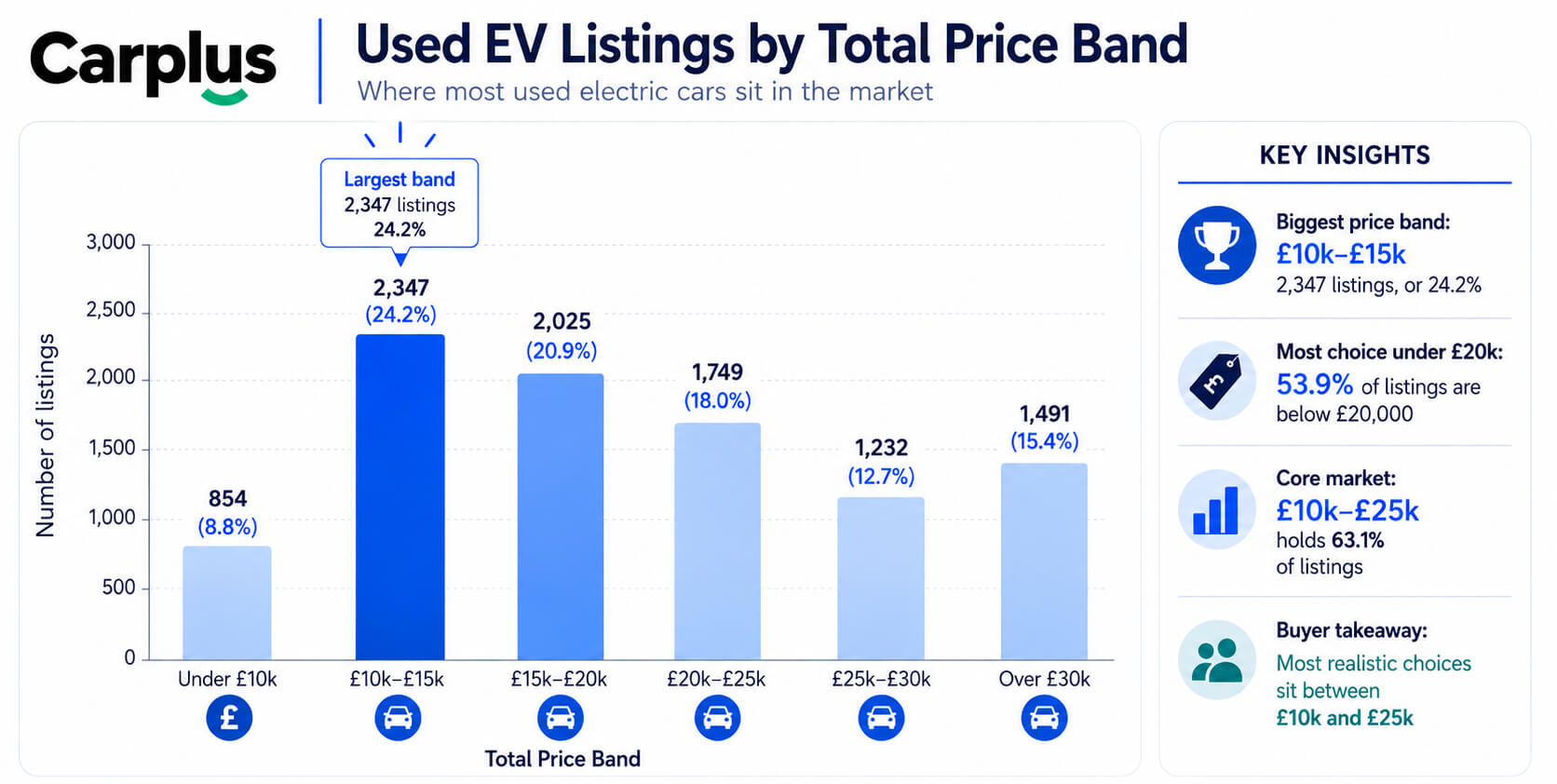
The median price in our dataset is £19,240. That's the middle of the market: half the listings are above it, half are below.
The middle chunk of the market (the middle 50% of all listings) sits between £13,490 and £26,414. If you're working out a budget, that's a reasonable range to plan around.
The most popular price band is £10,000 to £15,000, which covers nearly a quarter of all listings. If that's your budget, you're shopping in the busiest part of the market.
Used EV listings by price band
| Price Band | Listings | Share |
|---|---|---|
| <£10k | 854 | 8.81% |
| £10k–£15k | 2,347 | 24.20% |
| £15k–£20k | 2,025 | 20.88% |
| £20k–£25k | 1,749 | 18.03% |
| £25k–£30k | 1,232 | 12.70% |
| £30k+ | 1,491 | 15.37% |
What this means for you: You don't need to spend over £20,000 to find a decent range of options. But once you do cross that line, you'll generally get access to newer cars, lower mileage, and more brands to choose from.
Are newer used EVs worth the extra money?
Spoiler: newer cars cost more. Groundbreaking, we know.
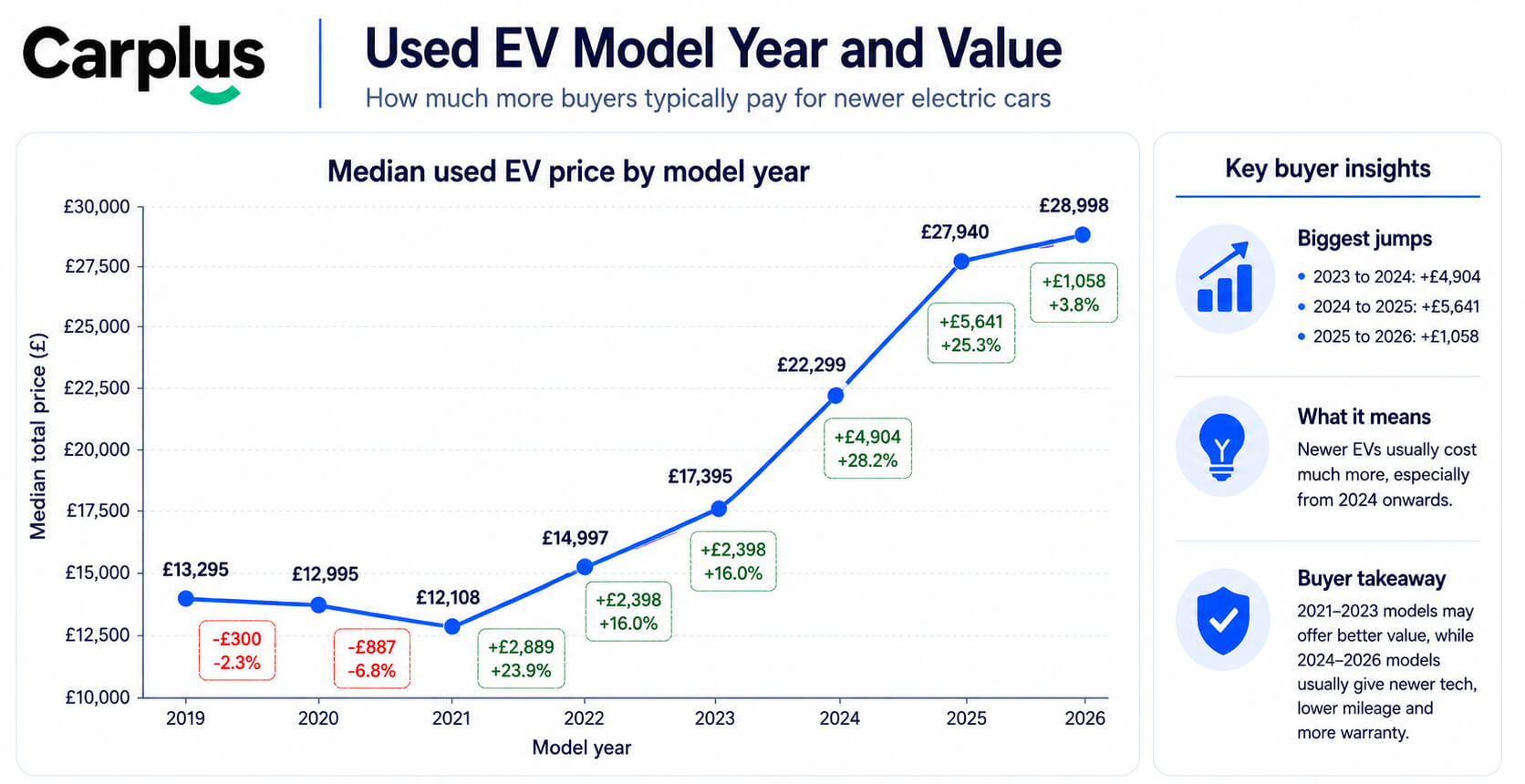
The more useful question is how much more and where the price actually jumps rather than just creeping up gradually. In our data, it's not a smooth climb. Prices rise fairly modestly through the early years, then take a sharp leap from 2023 to 2024.
Median used EV price by year
| Year | Listings | Median price | Median monthly price |
|---|---|---|---|
| 2016 | 27 | £7,495 | £164.07 |
| 2017 | 42 | £9,897 | £216.64 |
| 2018 | 63 | £10,350 | £226.57 |
| 2019 | 190 | £13,295 | £291.03 |
| 2020 | 521 | £12,995 | £284.47 |
| 2021 | 874 | £12,109 | £265.06 |
| 2022 | 1,887 | £14,997 | £328.29 |
| 2023 | 2,209 | £17,395 | £380.79 |
| 2024 | 1,292 | £22,299 | £488.14 |
| 2025 | 1,801 | £27,940 | £611.62 |
| 2026 | 792 | £28,998 | £634.78 |
That 2023-to-2024 jump is the one to pay attention to. The median price goes from £17,395 to £22,299 — nearly £5,000 more, or 28% up. Monthly payments follow: an extra £107 a month. For a car you're mostly using to get to work and back.
Is a 2024 car better than a 2023 one? Often, yes. You're likely getting more warranty left on the clock, a newer battery, better real-world range, faster charging, and more up-to-date everything. Fair enough.
But do you need all of that? If your daily drive is a commute, school run, or weekly shop — probably not. Do you really need the latest infotainment system to sit in traffic?
That's why 2021 to 2023 is worth a closer look. You're still getting a reasonably modern car with decent range and technology, but you're staying clear of that big pricing cliff that kicks in from 2024 onwards.
What this means for you: The newest isn't always the smartest buy. The sweet spot, for most practical use cases, is just before the market decides a car is suddenly worth £5,000 more.
How mileage affects used EV prices
Yes, mileage still matters on an electric car. No, it doesn't tell you everything. And no, low mileage doesn't automatically mean you've found a bargain.
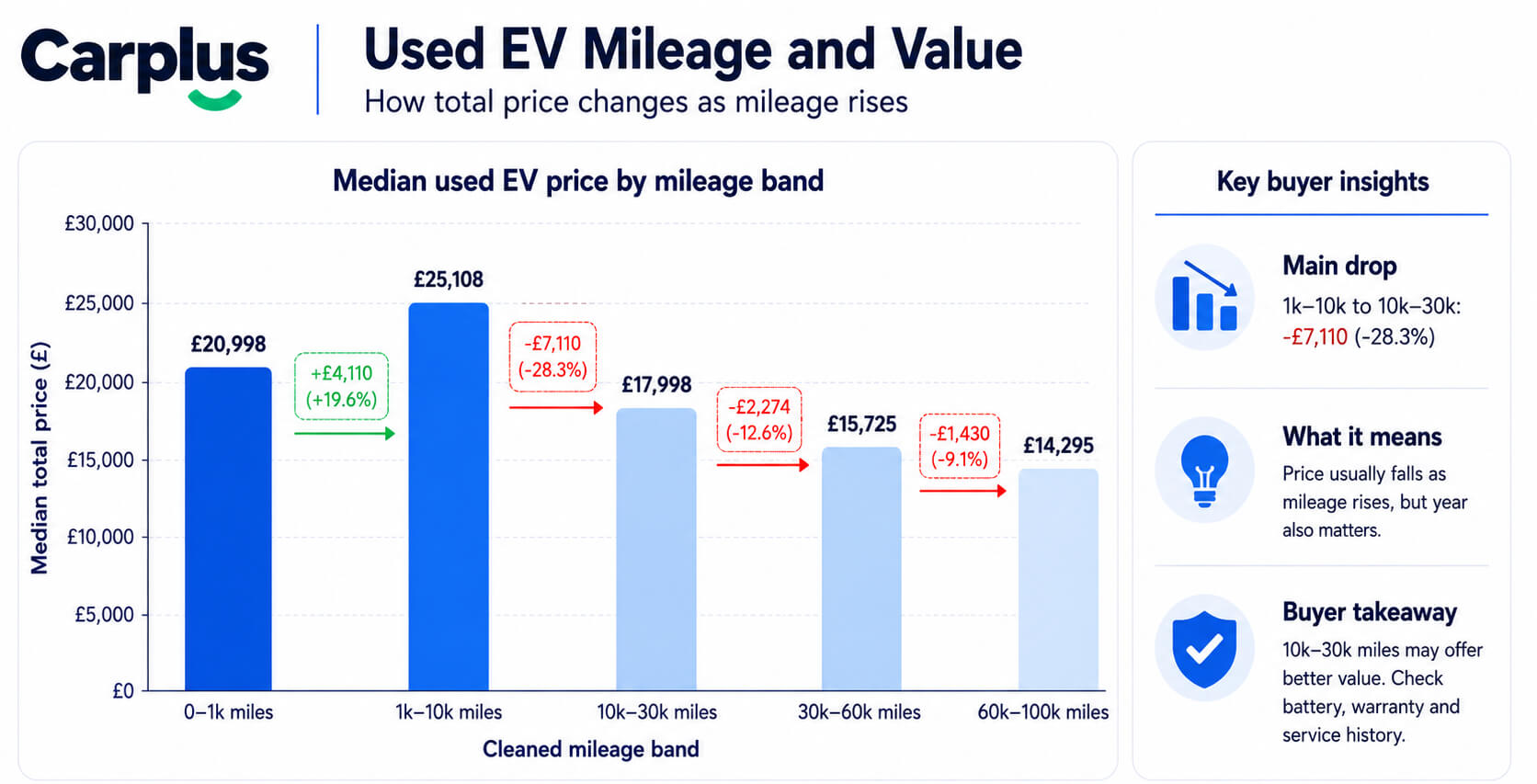
In fact, our data shows something a bit counterintuitive. The most expensive mileage band isn't the lowest — it's 1,000 to 10,000 miles. Nearly-new, barely-driven cars command a serious premium. After that, prices drop off sharply.
Median used EV price by mileage band
| Mileage band | Median price |
|---|---|
| 0–1,000 miles | £20,998 |
| 1,000–10,000 miles | £25,108 |
| 10,000–30,000 miles | £17,998 |
| 30,000–60,000 miles | £15,725 |
| 60,000–100,000 miles | £14,295 |
| 100,000–200,000 miles | £14,495 |
That fall from the 1,000–10,000 band to the 10,000–30,000 band is £7,110 — a 28% drop. For what? A few extra miles on the clock. Were those miles made of gold?
The 10,000 to 30,000 mile range looks like a reasonable place to start. You're not paying the obsessive-about-mileage premium, but you're also not buying something that's been through a taxi career. For most buyers doing normal daily driving, cars in this range are modern enough, priced sensibly, and available in decent numbers.
That said — and this is important — mileage is just one number. Before you get too attached to it, also check: battery condition, remaining warranty, charging history if available, service records, real-world range, and whether the mileage actually makes sense for the car's age. A 3-year-old EV with 8,000 miles sounds lovely until you wonder why it's barely been driven.
What this means for you: Don't pay a fortune chasing ultra-low mileage. The sweet spot is usually well before that — and your wallet will thank you for it.
Which used EV brands are cheaper or more expensive?
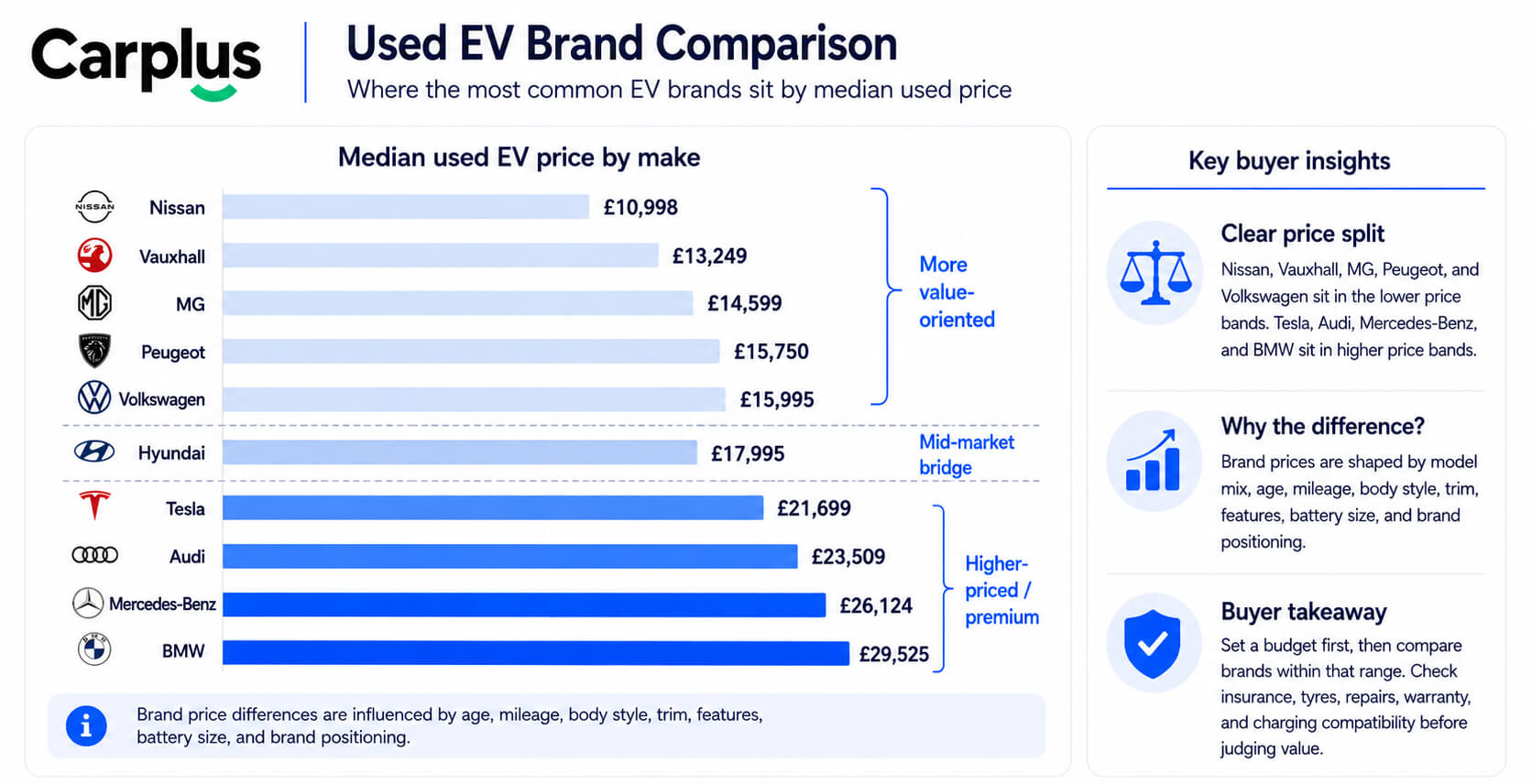
Nissan has the lowest median price among the brands we looked at, at £10,998. BMW has the highest, at £29,525. That's a difference of £18,527 — roughly the price of an entire Nissan, with change left over.
Median used EV price by brand
| Brand | Median price |
|---|---|
| Nissan | £10,998 |
| Vauxhall | £13,249 |
| MG | £14,599 |
| Peugeot | £15,750 |
| Volkswagen | £15,995 |
| Hyundai | £17,995 |
| Tesla | £21,699 |
| Audi | £23,500 |
| Mercedes-Benz | £26,124 |
| BMW | £29,525 |
Now, before anyone writes in to defend their badge of choice — brand price isn't just about the badge. A BMW sitting at £29,525 might be newer, larger, faster, better equipped, and packing a bigger battery than a Nissan at £10,998. So you're not always comparing like for like. The logo alone isn't why it costs more. Mostly.
The more useful question isn't "which brand is cheapest?" It's "which brands have realistic options at my budget?"
- If you're looking to keep costs down, Nissan, Vauxhall, MG, Peugeot, and Volkswagen are where the more accessible end of the market lives.
- If you want premium technology, stronger performance, or simply enjoy the feeling of a badge on your bonnet, Tesla, Audi, Mercedes-Benz, and BMW deliver that but you'll pay accordingly.
What this means for you: The brand table is a starting point. Use it to work out where your budget fits, then dig into the actual cars. A Nissan at £11k and a BMW at £30k are solving different problems for different people — neither is wrong.
What monthly payments tell us
Most people don't actually think about total prices. They think in monthly payments. Can I afford £400 a month? Is it a much more natural question than Can I afford £22,000? So we looked at that too.
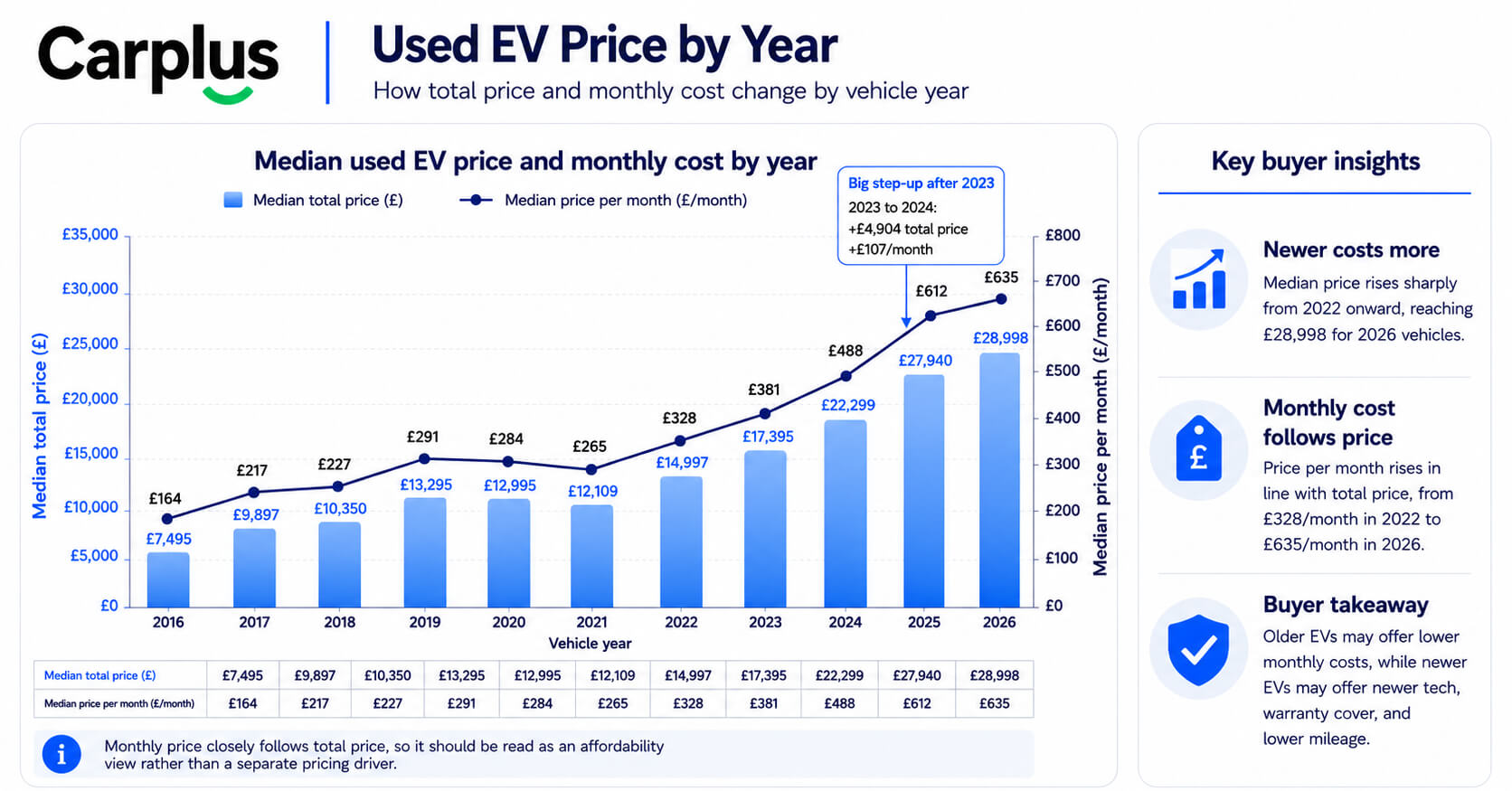
The pattern mirrors what we saw in the year-by-year price data. Monthly costs rise gradually through the early years, then jump sharply from 2023 to 2024 — an extra £107 every month. Whether that's worth it depends entirely on what you're getting for it.
By 2025, you're looking at over £600 a month. At that point you're not really shopping for a practical used EV anymore — you're shopping for a nearly-new car at nearly-new prices, and it's worth asking whether used is still the right category for you.
Is a lower monthly payment always the right call? Not necessarily. A cheaper monthly figure on an older car with sketchy battery history and no warranty left could cost you more in the long run than a slightly higher payment on something newer and more reliable. Monthly payments are a budget tool, not a value indicator.
What this means for you: If you've got a firm monthly ceiling, the year of the car is one of the quickest ways to filter your search. Anything from 2021 to 2023 is likely to keep you in the £265–£381 range. Cross into 2024 and above, and you're in different territory — make sure what you're getting justifies the jump.
What this means if you are buying a used EV
We looked at 9,706 used EV listings so you don't have to stare at them all yourself. Here's the full picture, as plainly as we can put it.
- Set your budget first. Not a rough idea of a budget. An actual number. Used EV prices swing wildly depending on brand, age, and mileage — and it's very easy to fall for a car that's £6,000 outside what you can realistically spend. Know your ceiling before you start browsing.
- Newer isn't always smarter. If you're mostly doing commutes and school runs, ask yourself honestly whether you need a 2024 car — or whether a solid 2021 or 2022 model does the exact same job for considerably less money.
- Don't obsess over mileage. A 40,000-mile EV with a healthy battery and full service history will almost certainly serve you better than a 7,000-mile one with unknown charging habits and no warranty left. Mileage is one number. It's not the whole story.
- The brand gap is real, but so is the reason for it. Know which end of the market makes sense for your life, and don't pay for badge prestige if what you actually need is reliable, affordable transport.
- Think beyond the monthly payment. Tyres, insurance, servicing, charging, battery condition, and what happens if something goes wrong all affect what the car truly costs you. A slightly higher monthly payment on a well-specced, warrantied car can easily be cheaper in practice than a bargain that keeps surprising you.
Methodology and notes
We analysed 9,706 used electric car listings across price, model year, mileage, brand, and monthly cost.
All figures use median values, not averages. Medians give a more accurate picture of a typical listing — averages can be skewed by a handful of unusually cheap or expensive cars at either end of the market.
These numbers are market guidance. They show where prices tend to sit, not what any individual car is worth. The right price for a specific car still depends on its model, condition, mileage, battery health, service history, remaining warranty, trim level, and real-world range.
Table of Contents