




You'll see "estate" on car listings, from small family cars to premium models, and some makers call theirs Touring or Avant instead. But what is an estate car, and how does it differ from a hatchback, a saloon or an SUV? It comes down to the roof and the tailgate.
What does estate car mean?
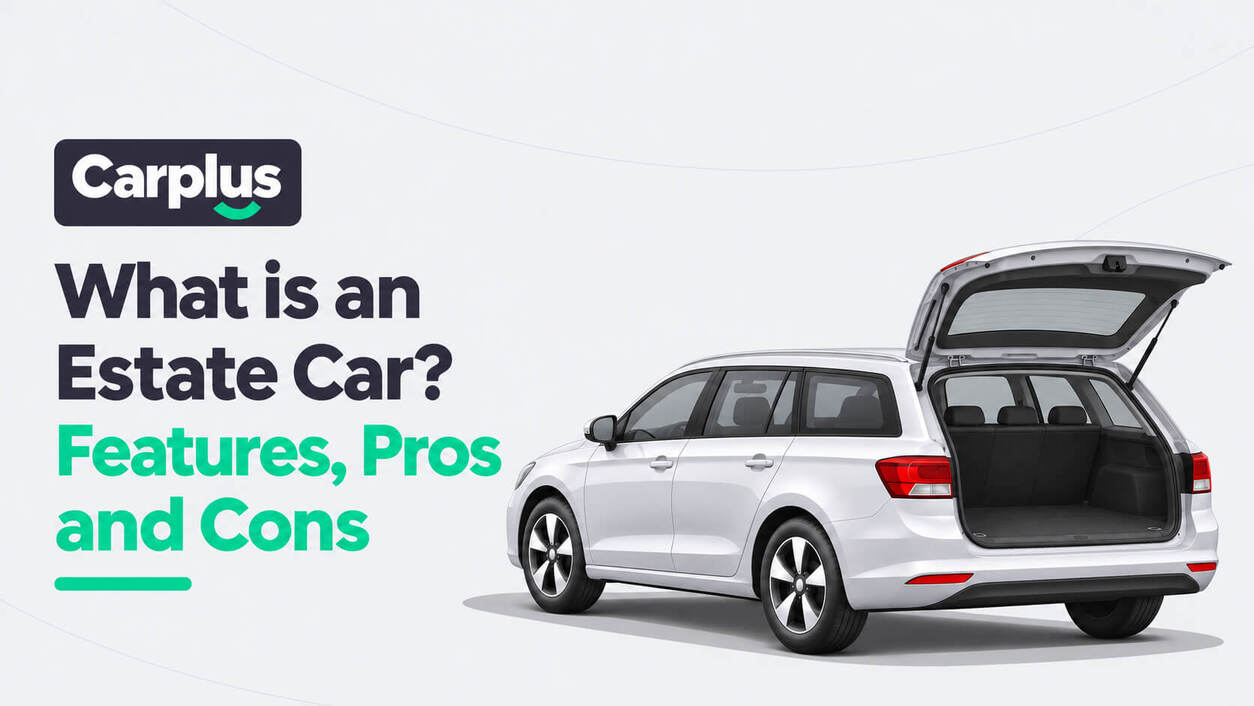
An estate car has a longer body than the saloon or hatchback it's based on, with the roof carried back over the boot. The boot sits behind the rear seats and opens straight into the cabin. There's no fixed panel or back window in the way.
Many estates are built on the same platform (the car's underlying structure) as a saloon or hatchback, so they drive much like one. That gives you the extra space without moving up to a taller car. And inside, most estate cars seat five across two rows, just like the car they're based on.
What are the key features of an estate car?
An estate car's key features all serve the boot, giving you a tall opening and a long floor:
- Full-height tailgate: the whole rear lifts, from the roof down to the bumper, so you load straight in.
- Level roofline: the roof carries on almost level to the back, so tall items fit further in.
- Split-folding seats: many models fold the back seats in a 60/40 or 40/20/40 split, so one long item can go in while a passenger still sits beside it.
- Flat floor: on many models the seats fold close to flat, which turns the boot and the back of the cabin into one long floor.
Roof rails, tie-down hooks and a load cover are common too. But you'll find those on hatchbacks and SUVs as well, so they don't decide the body style.
Is an estate a five-door car?
An estate is a five-door car, because the tailgate counts as a door alongside the four passenger doors. Hatchbacks, SUVs and crossovers count as five-doors for the same reason.
Estate car vs hatchback: what's the difference?
An estate car keeps its roof almost level to the back, while a hatchback's roof slopes down to the back window. Hatchbacks also have a tailgate that lifts with the glass, so the real difference is the shape of the space behind the rear seats.
| Estate | Hatchback | |
|---|---|---|
| Roof | Carries on almost level over the boot | Slopes down to the back window |
| Boot | Longer and taller, with a squarer rear | Shorter, with less height at the back |
| Length | Usually longer in the same class | Usually shorter |
| Parking | Can be harder in tight town spaces | Easier in small spaces |
The longer, squarer boot is why an estate carries more and longer items than a hatchback in the same class. A boxed lamp or a folded pushchair can stand upright, too. The Carplus hatchback guide covers how a hatchback differs from an estate from the other side.
Estate car vs saloon and SUV
An estate car opens its boot into the cabin, while a saloon closes its boot off behind a fixed back window. SUVs also have a tailgate that lifts with the glass. They just sit higher.
| Estate | Saloon | SUV | |
|---|---|---|---|
| Rear opening | Tailgate lifts with the glass | Boot lid, glass stays put | Tailgate lifts with the glass |
| Boot | Long, low and open to the cabin | Separate and closed off | Tall and open to the cabin |
| Seating position | Low | Low | High and upright |
| Best for | Luggage, long items, family trips | Quiet motorway miles | A clear view of the road |
Because its boot opens into the cabin, an estate takes bulkier loads than a saloon. In return, a saloon keeps luggage out of sight and tends to be quieter inside. There's more on what makes a car a saloon.
Next to an SUV, an estate sits lower, so you lift heavy items a shorter distance and step in more easily. SUVs win on height instead, with a higher seat and more room for tall items.
Is an estate bigger than an SUV, then? Well, an estate isn't automatically bigger, because it's often longer for its height while an SUV is taller. So compare the boots of the actual cars you're looking at, and see how an estate compares with an SUV for more.
What are estate cars called?
Estate cars go by different names depending on the maker, so the word "estate" may not appear on the listing. These are the badges you're most likely to see in the UK:
- Touring: BMW
- Avant: Audi
- Touring Sports: Toyota
- Sports Tourer: Vauxhall
- Sportswagon: Kia
- SW: Peugeot
Other makers keep it simple. Skoda, Mercedes-Benz and Volkswagen usually just say Estate on UK models, while Volvo puts a "V" in the model name, as in the V60.
Not every unusual badge means an estate, though. Audi's A5 Sportback isn't one, for example, because its roof slopes down to a back window that lifts with the boot. So whatever the badge says, look at the roofline from the side. If it stays level to the back, the car is an estate.
How much can an estate car carry?
A family-size estate car usually takes about 500 to 700 litres with the rear seats up. Fold the seats down and that rises to roughly 1,500 to 1,900 litres. But makers often measure the two figures to different heights, the parcel shelf and the roof.
Not every maker measures the same way either, so the shape of the boot often tells you more than the litres do. Before you buy, fold the seats and load what you carry most. Some seats leave a slope rather than a flat floor, and some boots have a high edge to lift things over.
Are estate cars popular in the UK?
Estate cars are a small part of the UK market, with under 4% of new-car sales in early 2024. That's less than half the European average. SUVs, by contrast, now take about two in three new-car sales in the UK.
Estates haven't disappeared, though. The Toyota Corolla Touring Sports was the UK's best-selling estate in early 2024, and Skoda, Volkswagen, BMW and Mercedes-Benz still sell new ones too.
Some familiar models have gone from the new-car market, including the Ford Mondeo, Vauxhall Insignia Sports Tourer and Mazda 6 Tourer. They still turn up used, so the second-hand choice is wider than the showroom's. An estate a few years old costs less, too. In the Carplus study of UK used car prices, a typical car was about £1,415 cheaper for each extra year of age.
Pros and cons of an estate car
An estate car's main strength is a long, low boot with a car-like drive. Its main drawback is a longer body that can be harder to park.
Pros
- A big boot without the height: many models carry close to what an SUV does, but you lift things in at a lower height.
- Easy loading: the full-height tailgate and low boot floor make bulky or heavy items simpler to get in.
- A car-like drive: it handles like the saloon or hatchback it's based on, which suits long motorway journeys.
Cons
- Low seating position: the low height that helps loading also means you sit lower than in an SUV.
- Longer body: many models are longer than their hatchback version, so tight spaces can be harder.
- Rear view when loaded: a boot packed to the roof can block the back window, so you'll rely on the door mirrors.
- Smaller choice when new: several mainstream models have left the market, so some are only available used.
Who is an estate car best for?
An estate car suits drivers who carry a lot but still want a car-like drive. Need room for the family and the holiday luggage, or bikes, golf clubs and a dog crate? An estate fits.
This body style is a weaker fit if you'd rather sit high or carry heavy, dirty loads. For a high seat, look at an SUV or one of the cars with high driving positions. For building materials, a van will cope better.
Are estate cars cheap to insure and run?
An estate car usually costs about the same to insure, tax and fuel as a hatchback or saloon with a similar price and engine. Body style doesn't set any of those bills. This guide to what it costs to run a car breaks each one down.
Insurance follows the model's insurance group, from 1 (cheapest) to 50. So a performance version usually costs more to cover than a standard one.
Road tax follows CO2 emissions and list price, as the current vehicle tax rates on gov.uk show. And since many new premium models cost over £40,000, they can also pick up the expensive car supplement, an extra yearly charge.
Can you buy an estate car on finance?
You can buy a new or used estate car on finance, as long as a lender is happy the repayments fit your income. The usual routes are Hire Purchase (HP) and Personal Contract Purchase (PCP). With both, the lender owns the car until the last payment, so falling behind can mean losing it.
Carplus arranges finance on cars from £4,000 to £40,000 at any UK dealer, which covers many used estates. A free car finance eligibility check uses a soft search, so it won't affect your credit score.
Table of Contents