




Two listings can call near-identical cars a crossover and an SUV, and a car sold as a coupe can have four doors. Labels don't always help.
So what are the main car body types in the UK, and how do you tell them apart? The shape you pick changes how much you can load and how easy the car is to live with.
What are the main car body types?
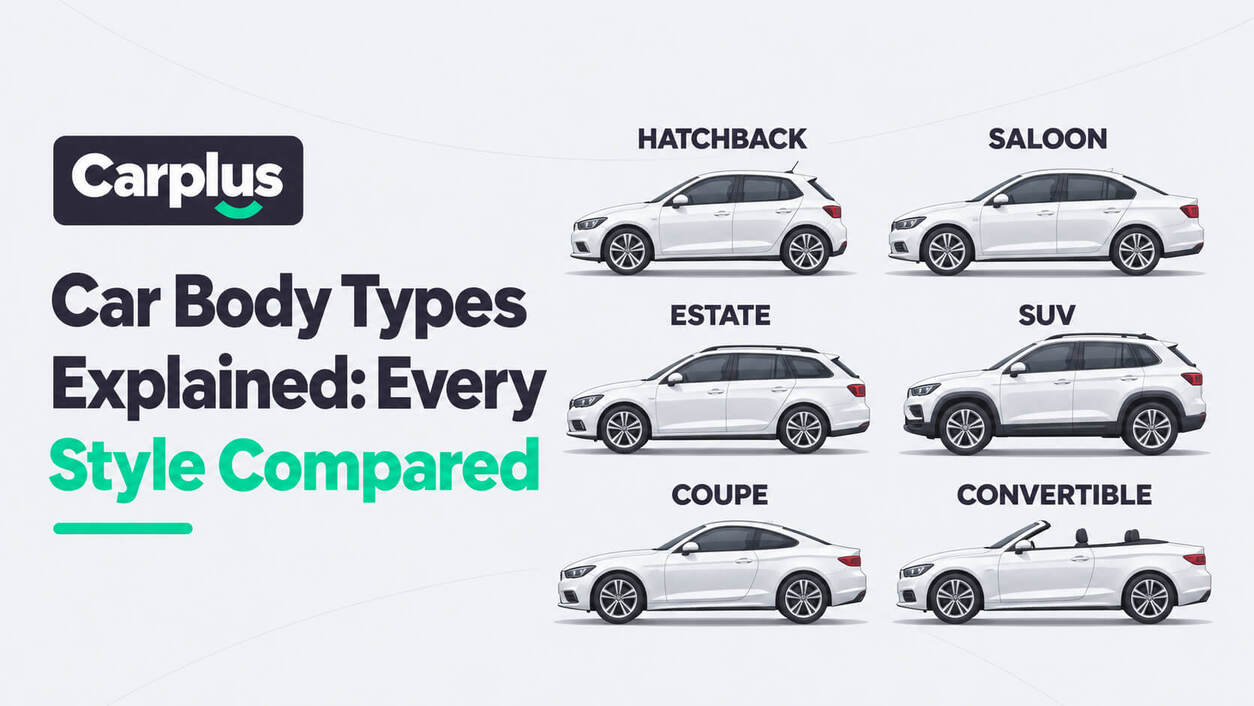
The 7 main car body types are the hatchback, saloon, estate, SUV, MPV, coupe and convertible, and together they cover most cars on UK roads. No official list exists. So the number you see in a guide depends on who is counting and whether they include size classes and work vehicles.
| Body type | Boot | Roof | Doors | Seats |
|---|---|---|---|---|
| Hatchback | Opens with the rear window, into the cabin | Fixed, slopes towards the tail | 3 or 5 | Usually 5 |
| Saloon | Separate, with its own lid | Fixed, three sections | Usually 4 | Usually 5 |
| Estate | Opens with the rear window, long flat floor | Fixed, stretches back over the load area | Usually 5 | Usually 5 |
| SUV and crossover | Opens like a hatchback's | Fixed, tall and upright | Usually 5 | 5 or 7 |
| MPV | Wide opening, flexible seats | Fixed, tall and boxy | 5, some with sliding rear doors | 5 to 7, a few up to 9 |
| Coupe | Smaller than a saloon's | Fixed, low and sloping | Traditionally 2 | 2 to 4 |
| Convertible | Smaller, especially with the roof down | Folds or lifts away | 2 or 4 | 2 to 4 |
What is the most common car body type in the UK?
The SUV is now the most common car body type among new cars in the UK. The SMMT, the motor industry's trade body, puts its dual purpose class, which covers most SUVs, at 38.2% of new car registrations in 2025. That's more than any other class.
Hatchbacks still make up the largest share of cars already on the road. The SMMT groups cars by size rather than shape, and its two largest classes, superminis and lower medium cars, are mostly hatchbacks. Some small crossovers, such as the Ford Puma, count as superminis too.
Superminis are the biggest group on UK roads, at about 11.9 million cars in 2025. Lower medium cars come second and SUVs third. The same order held in 2025 used car sales, so hatchbacks are still the easiest body type to find second-hand.
MPVs are now one of the rarest new body types, at 3.7% of 2025 registrations.
What is each body type like?
Each body type trades space for style or comfort in its own way. The best fit depends on what you carry and where you drive.
Hatchback
A hatchback opens at the back with a single door hinged at the roof, and the rear window lifts with it. The boot opens straight into the cabin with no separate lid. Most rear seats fold, too.
Hatchbacks come with three or five doors. They range from small city cars to family models. Most are compact enough for town driving and small families, but a hatchback carries less than an estate or an SUV.
If you mostly need to get from A to B, it's usually one of the cheapest shapes to buy and run. Common examples include the Volkswagen Golf, Vauxhall Corsa and Toyota Yaris. The guide to what makes a car a hatchback goes into more detail, and these best used hatchbacks in the UK are a good shortlist.
Saloon
A saloon has a separate boot behind the rear seats, closed off from the cabin by a fixed rear window. Seen from the side, the bonnet, cabin and boot form three separate blocks, so it's called a three-box shape.
A saloon suits long motorway journeys and company-car use. But the boot lid limits what you can load, because bulky items have to fit through a smaller opening. You'll notice it the first time you try to load a bike or a flat-pack box.
Among the best-known saloons are the BMW 3 Series and Mercedes C-Class.
Estate
An estate is a saloon or hatchback with its roof stretched back over a larger luggage area. That longer roof gives a long, flat load space. It suits dogs and bulky loads.
But an estate is usually a little longer than the car it's based on, which can make parking harder. In a tight multi-storey, that extra length shows.
Two popular estates are the Skoda Octavia Estate and Volvo V60. If you're torn between a long boot and a high seat, see how an estate compares with an SUV.
SUV and crossover
An SUV is a tall, upright car that sits well clear of the road. From the higher seat you'll see further down the road, and the cabin has more room than a hatchback of the same length. That suits families.
But an SUV usually costs more to buy and run.
A crossover is the smaller, more car-like end of the SUV range, built on the same base as a hatchback. The Kia Sportage is a mid-size SUV, while the Ford Puma is a small crossover.
There's more on how a crossover differs from an SUV. Or start with the best used SUVs to buy now.
MPV
An MPV, or people carrier, is a tall car built to carry more passengers and their luggage. Most have five to seven seats, and a few go up to nine, with rear seats that fold, slide or lift out.
An MPV suits big families and luggage-heavy trips, but its tall, boxy body puts practicality ahead of looks. On many models, sliding rear doors make tight car parks easier.
Popular choices include the Dacia Jogger and Citroën Berlingo. The guide to what an MPV is and how it compares covers car-based and van-based models, and here's MPV or SUV for a family car.
Coupe
A coupe has a low, sloping roofline and traditionally just two doors, though some now have four. That shape trades rear headroom and boot space for looks and driving feel, so a coupe suits one or two people better than a family. Climb into the back of a two-door model and you'll see why.
Two-door examples include the BMW 2 Series and Mercedes CLE.
Convertible
A convertible has a roof that folds or lifts away, so you can drive in the open air. The roof is either fabric (a soft-top) or folding metal (a hard-top).
A convertible suits weekend and sunny-day driving more than daily family use. Why? The boot is smaller, especially with the roof down.
Think of the Mazda MX-5 or the MINI Convertible.
How can you tell car body types apart?
The quickest way to tell car body types apart is to look at the back of the car. A rear window that lifts with the boot door points to a hatchback or an estate. If the window stays fixed above a separate boot lid, it's a saloon.
The roof helps too. On an estate it stretches back over the load area, and on a convertible it folds away.
Doors are a weaker clue. They vary within the same body type.
Are four-door coupes really coupes?
Four-door coupes have a sloping roofline and four doors, and how the boot opens decides what they are in everyday use. If the back window lifts with the boot door, the car behaves like a hatchback. If the boot has its own lid, it behaves like a saloon.
Car makers sell these cars as liftbacks, Sportbacks or Gran Coupés. The label varies, but the boot opening doesn't.
Other names for the same body types
Several body types go by more than one name, depending on the car maker or the country.
| Name you'll see | What it means |
|---|---|
| Sedan | Saloon, the word used in some countries |
| Cabriolet | Convertible |
| Roadster | A two-seat convertible |
| People carrier | MPV |
| Touring, Avant, Tourer | Estate, as used by some makers |
| Shooting brake | Often an estate with a sportier roofline |
| CUV | Crossover |
Which car body type is right for you?
The right car body type for you depends first on how many seats and how much luggage you need. Where you park and drive comes next.
| If you need | Look at |
|---|---|
| Room for five people, or three child seats | An MPV or a larger SUV |
| Space for dogs and bulky loads | An estate |
| Easy town parking and short trips | A hatchback |
| Comfort on long motorway miles | A saloon or an estate |
| A higher seat that's easier to get into | An SUV, crossover or MPV |
| Weekend drives for one or two people | A coupe or a convertible |
With a three-door hatchback, rear passengers climb in past a folded front seat. So a five-door suits anyone who carries passengers often.
Some needs have their own guides, such as cars with a high driving position, cars that take three child seats and the best cars for snow and ice.
Body type is only one filter, so weigh it against your budget and running costs too.
Which car body types suit UK drivers best?
Hatchbacks and small crossovers suit most UK drivers best, because they fit easily into a standard parking bay. A typical UK bay is 2.4 metres wide and 4.8 metres long, a size that hasn't changed since the 1970s.
Many larger cars no longer fit that space. More than 160 tested models are longer than a standard bay, and the list of cars too big for parking spaces includes many large SUVs and luxury models. Opening the doors can be a squeeze, too.
So a large SUV, a long estate or a seven-seat MPV makes most sense if you have a driveway or regularly need the space. Whatever you choose, measure where you park before you fall for a bigger car.
Do car body types affect insurance, road tax and running costs?
A car's body type changes its running costs mainly through weight, size and tyres. Road tax and insurance follow the individual model. A taller or heavier body burns more fuel, though a hybrid or electric version narrows the gap.
Insurers price cover partly by insurance group, a scale from 1 (cheapest) to 50 set for each model. Road tax, officially Vehicle Excise Duty (VED), also follows the model, through its CO2 emissions and list price. Two cars with the same shape can cost very different amounts to insure and tax.
So get an insurance quote for the exact car before you choose it, and check the current vehicle tax rates on gov.uk. The Carplus breakdown of what it costs to run a car covers each bill.
Is any car body type safer than the rest?
No car body type is safer by default, because Euro NCAP, the independent crash-testing programme, rates each model separately. A taller car doesn't automatically mean a safer one.
Euro NCAP gives each new model a rating from 0 to 5 stars. Look up the exact model and its test year in the latest Euro NCAP safety ratings.
Can you buy any car body type on finance?
You can buy almost any body type on finance, because lenders look at the car's price, age and mileage and at your income, not its shape. Carplus arranges finance on cars from £4,000 to £40,000 with up to 120,000 miles, which covers most used hatchbacks, estates, SUVs and MPVs. And we can arrange it through any UK dealer, so the car doesn't have to come from one showroom.
With Hire Purchase (HP), you own the car outright after the final instalment. With Personal Contract Purchase (PCP), monthly payments are usually lower. You keep the car only if you pay the optional 'balloon payment', a final lump sum.
To see what you could borrow, try the Carplus car finance eligibility checker. The checker runs a soft search, which other lenders can't see.
Table of Contents