




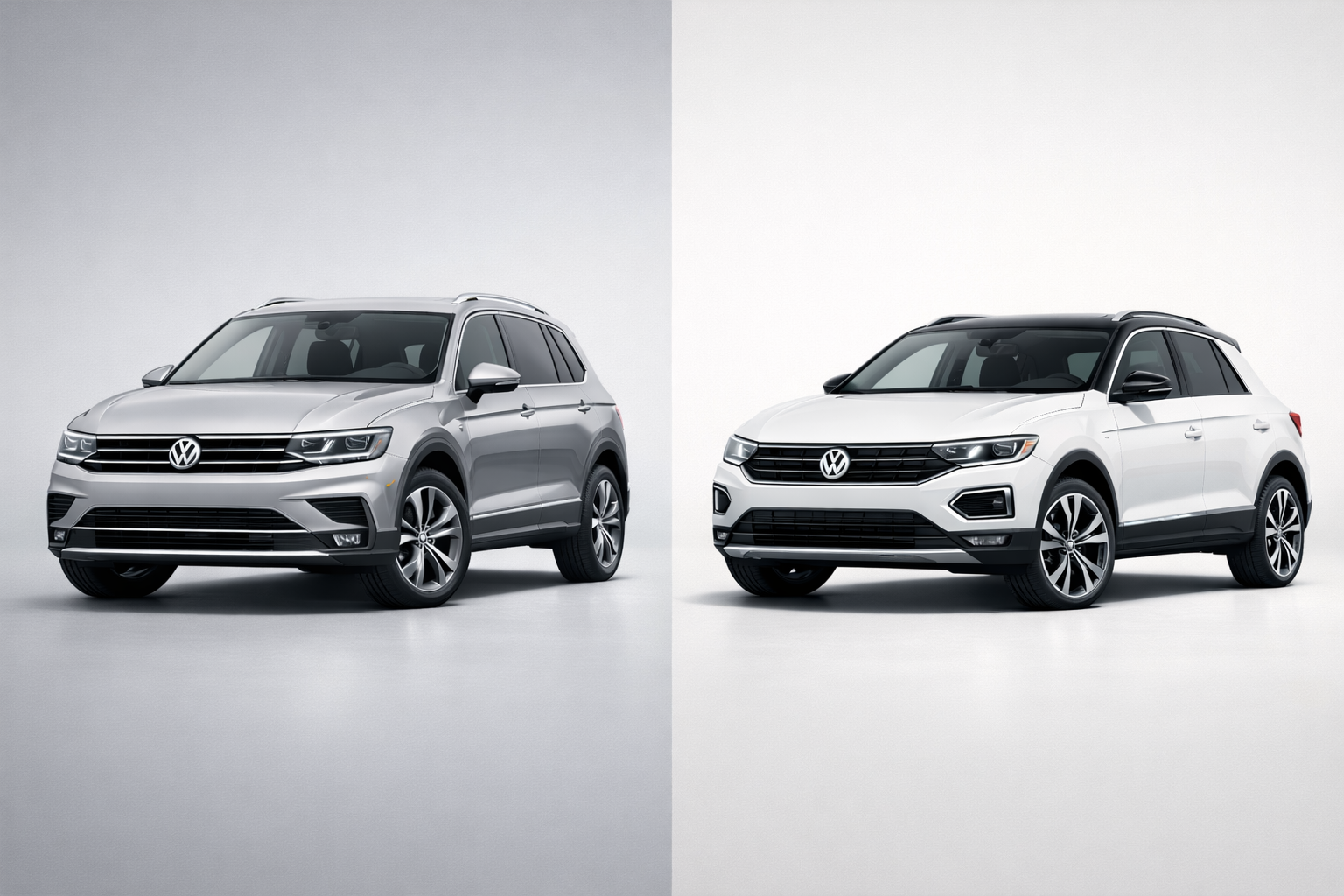
The Volkswagen T-Roc and Tiguan go head-to-head in a family-style showdown, and you get to pick the favourite.
With these two VW SUVs, you have to pay attention to the details: size, trims, engines, and technology, all of which shape the experience. Both the T-Roc and Tiguan deliver a strong, reliable drive, so whichever you choose, it will feel like the right fit. Read our full review to see everything up close.
Quick comparison at a glance
When it comes to Volkswagen T-Roc vs Volkswagen Tiguan, these crossover SUVs are two sides of the same family:
T-Roc | Tiguan | |
Engines | Petrol: 1.0-2.0 TSI, diesel: 2.0 TDI, T-Roc R up to 296hp | Petrol: 1.5-2.0 TSI, diesel: 1.5-2.0 TDI, eHybrid PHEV up to 227hp |
Performance (0-62mph) | 10.6 s (standard) / 4.9 s (R) | 7.2 s (PHEV) / 8.5 s (2.0 TSI) |
Ride & handling | Light steering, comfortable, sporty feel, good cornering | Composed, commanding SUV feel, comfortable for long drives |
Practicality | Smaller boot, slightly tighter rear seats, flexible for class | Spacious rear seats, very large boot, flexible seating (Allspace 7-seater) |
Strengths | Cheaper, sporty feel, compact, practical for small families | More spacious, premium interior, versatile, PHEV option |
Weaknesses | Smaller, less premium, no hybrid | More expensive, heavier |
Price comparison
You can expect to pay roughly £9,000-£11,000 for a 2018 Tiguan, compared with around £12,000-£13,000 for a 2018 T-Roc.
For new cars, the 2026 Tiguan ranges from £38,000 to £53,000, and the 2026 T-Roc starts from £29,600 up to £38,500. If you’re considering sporty trim levels (R-Line), the prices rise towards the top of these ranges.
Volkswagen Tiguan vs T-Roc: Size and dimensions
T-Roc:
- Length: 4,236 mm
- Width: 1,819 mm
- Height: 1,584 mm
Tiguan
- Length: 4,539 mm
- Width: 1,501 mm
- Height: 1,660 mm
The Tiguan clearly takes the lead with more length and height, which translates to extra interior and cargo space. The T-Roc, with its smaller size, feels easier to park and manoeuvre in tight spots.
Engine options
The Volkswagen Tiguan and T-Roc both offer a range of engines. A 1.0-litre turbocharged petrol engine in the T-Roc is the entry-level option. Most buyers opt for the 150hp 1.5 TSI paired with either front-wheel drive or all-wheel drive and an optional DSG automatic gearbox. Higher-spec T-Roc models include the 2.0-litre petrol or diesel engines, with the top 300hp T-Roc R delivering sportier performance.
The Tiguan offers similar petrol options, including 1.5-litre 150hp TSI and 2.0-litre models producing up to 320hp, alongside diesel variants, such as the 2.0 TDI. There’s also a plug-in hybrid version that combines electric and petrol power for efficiency and flexibility.
Performance
Both the Tiguan and T-Roc deliver a comfortable and capable driving experience, with some differences in feel and dynamics. The T-Roc is lighter and slightly sportier, which gives it agile handling and a responsive feel in corners. Its ‘R’ model takes this further, with more power and sharper performance for those who enjoy a more engaging drive.
The Tiguan is mostly focused on composure and a smooth ride quality that absorbs bumps and road imperfections. Still, the car is competent enough when pushed.
The T-Roc picks up pace quickly, with the ‘R’ model noticeably sharper. The Tiguan reaches speed smoothly, steadily, and in a controlled manner.
Interior
The Volkswagen Tiguan offers more interior space, which is more practical than the T-Roc. The materials feel solid, with soft-touch surfaces and a nice finish. The cabin includes multiple storage options, including door bins, cupholders, and a central console, and the rear seats can slide and recline to adjust space for passengers or cargo. The optional 7-seat Allspace adds flexibility for extra passengers, though the third row is best suited to shorter trips.
The T-Roc has a smaller, well-organised cabin. The layout is intuitive, with controls and infotainment within easy reach. Some of the plastics aren’t as soft as those in the Tiguan, but the materials feel durable, and storage is practical, with compartments in the doors, glovebox, and centre console. Seating is comfortable for four adults, with enough room for everyday use.
Boot space
The Tiguan’s boot is genuinely spacious for a mid-size SUV, with up to 652 litres of cargo volume in standard versions. It’s one of the largest boots in its class and is well-suited for family holidays and big shopping trips. Even with a plug-in hybrid layout, the Tiguan still offers a generous 490 litres, comfortably beating the smaller T-Roc.
You can fold the rear seats using boot-mounted levers, but the load floor doesn’t become fully flat.
By comparison, the T-Roc’s boot measures around 445 litres with the rear seats up. This is still respectable for a compact SUV and more than enough for most weekly shopping runs or airport luggage for a small family. Folding the rear seats increases the capacity to about 1,290 litres.
Do note that four-wheel-drive T-Roc models have a slightly smaller boot (about 392 litres) due to the raised floor required for the 4WD hardware.
Technology
Wireless Apple CarPlay and Android Auto are standard on both. Bluetooth, DAB radio, parking sensors, and available wireless phone charging are also common across the range, depending on the trim.
The T-Roc keeps things simple and easy to use. Most versions come with an 8-inch infotainment screen that uses a clear tiled layout with shortcut buttons. Higher trims and newer models improve the setup with better graphics, digital driver displays, and optional built-in sat-nav.
The Tiguan features larger infotainment screens, and newer versions can have displays of up to 15 inches, which gives the cabin a more upmarket feel. The infotainment software is more customisable, too. Sat-nav, automatic lights and wipers, and more advanced digital displays are more widely available across the Tiguan range.
Safety and driver assistance
Both the T-Roc and Tiguan reflect the VW Group’s strong approach to safety, with both models earning a five-star Euro NCAP rating.
Across the range, you get key driver-assistance systems such as automatic emergency braking, lane-keep assistance, and adaptive cruise control. Depending on specification, both can also be equipped with parking sensors, reversing cameras, and, on higher-spec Tiguan models, more advanced aids (such as surround-view cameras and parking assistance).
Running costs and ownership
When it comes to T-Roc vs Tiguan, running costs and ownership can play a major role in the final decision. Let’s break it down.
Fuel and energy efficiency
The T-Roc’s 1.0-litre petrol averages 55.4mpg, while the 1.5 TSI petrol manages around 53.3mpg (51.4mpg with the automatic). The 2.0-litre petrol and diesel engines are less economical, especially with four-wheel drive. The 2.0 diesel with 4WD returns up to 56.5mpg, the most efficient overall.
The Tiguan is slightly larger but remains reasonably economical for its size. The 128hp 1.5 TSI petrol achieves 44.8mpg, and the 148hp 1.5 TSI petrol manages 40.4mpg. The diesels are more efficient, with the 2.0 TDI in S trim reaching 50.4mpg. The Tiguan plug-in hybrid offers a small electric-only range of around 77 miles and mid-50s mpg.
Insurance
Insurance costs for the T-Roc fall between groups 13-26. The Tiguan, being larger and offering more powerful engines and premium trims, ranges from groups 11-35. In both cases, entry-level models are surprisingly affordable to insure, but top-spec or high-performance versions push insurance significantly higher.
Servicing
Older T-Rocs and Tiguans over three years old have fixed-price maintenance, with minor services around £184 and major services about £354. Routine upkeep is straightforward, and parts availability through VW dealerships is good, though some minor delays in repairs or part procurement can occur depending on location.
Tax
For road tax, both models currently fall under the flat £195 per year system for most engines. Vehicles that cost over £40,000 when new also face the luxury surcharge of £425 per year, so consider whether higher trims are worth it before buying.
Depreciation
Both the T‑Roc and Tiguan tend to hold their value fairly strongly compared with many rivals, but depreciation is influenced more by how they’re specified, maintained, and used than by size alone.
How Carplus can help with financing the car you want
At Carplus, we make it easier for you to get the car you want without worrying about the upfront costs. You can choose a Volkswagen SUV or any other car, and we’ll still offer flexible financing plans, with options for lower monthly payments or shorter repayment periods.
We guide you through every step of the process. You’ll get clear information about monthly instalments, interest rates, and any credit checks. Our team is here to answer your questions and explain the details in simple terms. Apply in minutes!
Who is the Volkswagen Tiguan for?
The Tiguan works well for people who need a larger, more practical SUV that feels comfortable and capable on longer drives. Consider it if you carry passengers or luggage regularly and want a versatile vehicle for everyday life.
Who is the T-Roc for?
The T-Roc fits people looking for small SUVs that are easy to use in town but still comfortable on longer trips. It should work well for you if you want a stylish car without the bulk of a larger SUV.
Verdict
Overall, both the Tiguan and T-Roc deliver a capable, reliable, and enjoyable SUV experience, making it a choice between space and practicality and compact convenience. All the best on the road!
Table of Contents