




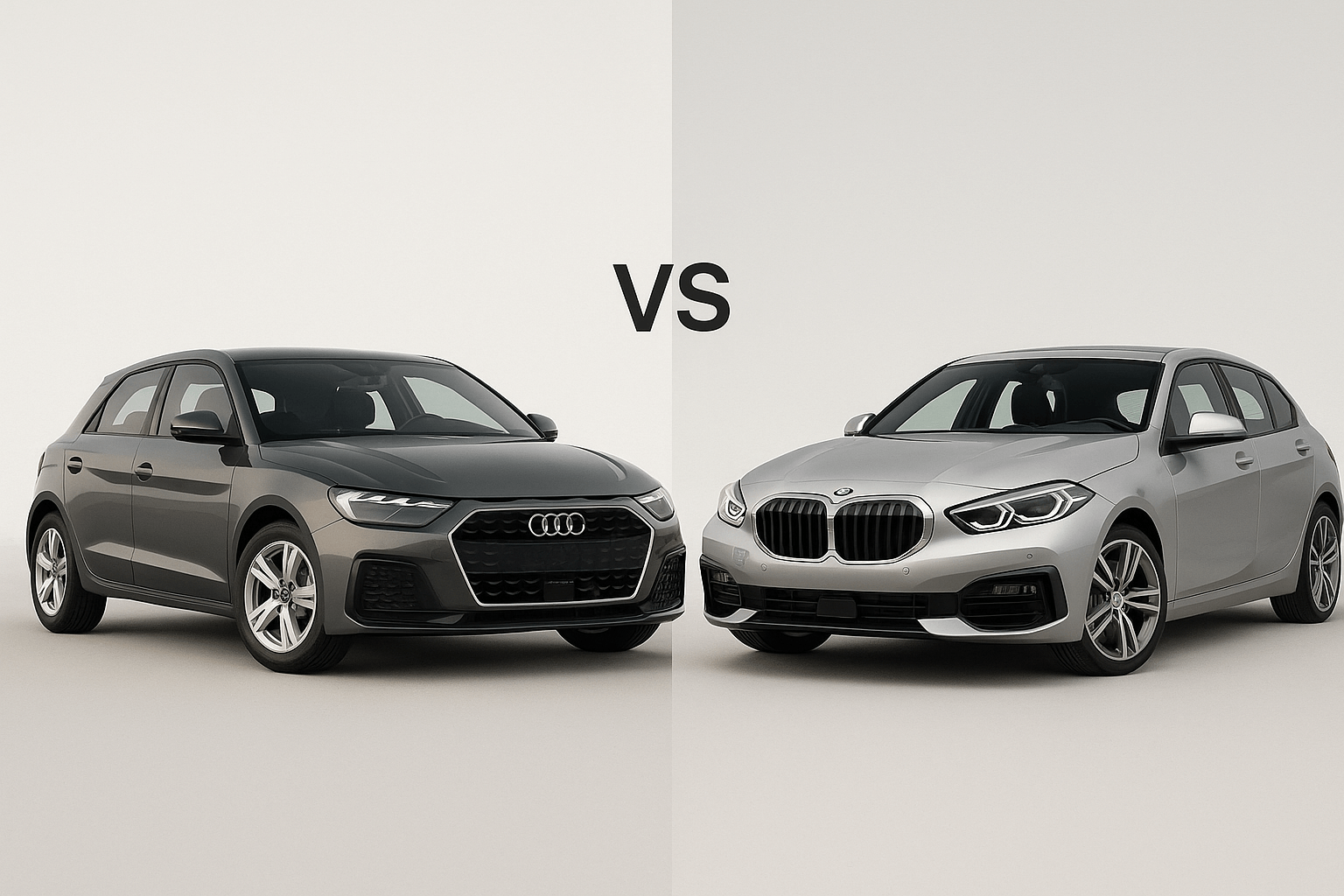
The Audi A1 and BMW 1 Series aren’t direct rivals, but they could easily share a shortlist. The A1 sits in the premium supermini segment, and the 1 Series tackles slightly larger hatchbacks like the Audi A3 and Mercedes A-Class. Both promise refined driving, quality interiors, and a prestigious badge.
If you’re choosing between the Audi A1 and BMW 1 Series, this guide will help you make an informed decision.
Quick comparison at a glance
Here are a few key features to know about the Audi A1 and BMW 1 Series:
Audi A1 | BMW 1 Series | |
Segment | Premium supermini | Premium compact hatchback |
Engines | 1.0-2.0-litre petrol, 93-200hp | 1.5-2.0-litre petrol/diesel, 114-306hp |
Transmission | 5/6-speed manual or 7-speed auto | 6-speed manual or 7/8-speed auto |
Drive | Front-wheel drive | Front-wheel drive (higher models AWD) |
Driving experience | Nimble, city-friendly, comfortable | Sporty, dynamic, fun on country roads |
Interior | Modern, digital cluster standard, premium feel | Spacious, high-quality, spec-dependent |
Practicality | 5 doors, 335-litre boot (1,090 litres folded) | 5 doors, 380-litre boot (1,200 litres folded) |
Rear passenger space | Adequate for average adults | Roomier, more comfortable for longer journeys |
Now, it’s time to get into the full comparison in detail.
Price comparison
The Audi A1 and the BMW 1 occupy slightly different brackets. The Audi A1 starts from around £24,000 for a new car and rises to £33,500 for higher-spec models. A used Audi A1 from 2018 can be found for £7,500-£9,000.
The BMW 1 Series may have a higher starting point, with new models from £32,000 up to £50,500. That said, a 2018 used 1 Series is similarly priced to the A1 at around £7,500-£8,000.
Find car finance deals with the best rates!
My monthly budget is
Audi A1 vs BMW 1 Series: Size and dimensions
BMW 1 Series:
- Length: 4,319 mm
- Width (excluding mirrors): 1,799 mm
- Height: 1,434 mm
- Wheelbase: 2,670 mm
Audi A1:
- Length: 4,029 mm
- Width: 1,740 mm
- Height: 1,409 mm
- Wheelbase: 2,469 mm
So, compared to the A1, the BMW 1 Series is slightly larger in every direction: longer, wider, and a bit taller. That extra length and width make the 1 Series feel less cramped than the A1, particularly for rear-seat passengers.
Engine options
The Audi A1 comes with a variety of petrol engines. The entry-level 1.0-litre three-cylinder engines are economical choices for urban and suburban driving. The 40 TFSI model steps up to a 1.5-litre turbocharged petrol engine for a bit more power.
The BMW 1 Series’ petrol options start with a 1.5-litre three-cylinder engine for economy and ease of use. Also, there is a 2.0-litre turbocharged petrol available for those requiring higher capacity. Diesel engines range from 1.5-litre three-cylinder units to 2.0-litre four-cylinder options, with strong fuel efficiency.
Performance
Both the Audi A1 and BMW 1 Series offer a sporty driving experience. The A1 feels grown-up to drive, and light and easy to steer around town, yet with enough weight at higher speeds to make you feel secure. On tighter bends, this small car shows a slight lean, but grip remains ample.
S-line trim adds stiffer sports suspension, which keeps the body more upright through corners. However, it doesn’t make the A1 the sharpest handler in its class.
The BMW 1 Series provides a more varied setup, with standard front-wheel drive on most models and the option of xDrive all-wheel drive for the sportier M135i. This allows sharper handling and greater traction, especially in more powerful variants. Later models switched from rear- to front-wheel drive, which improved traction and predictability.
Many 1 Series models come with a seven-speed dual-clutch automatic gearbox. Shifts feel smooth in normal mode and sharper in the Sport setting. Just bear in mind that from a standstill, there is a noticeable pause between pressing the accelerator and the car getting underway.
Interior
The Audi A1 boasts a clean and simple interior that prioritises comfort. It offers generous headroom and legroom for front passengers, but the rear seats are only comfortable for shorter journeys. Storage solutions include a decent glovebox, door bins, cupholders, and small cubbies that make day-to-day use easier. The interior is spacious enough to carry shopping, small bags, or personal items without cluttering the cabin.
The BMW 1 Series also emphasises practicality. In terms of interior space, it provides slightly more room than the A1 for both front and rear passengers. Storage options are more generous, with larger door pockets and a bigger glovebox. The cabin materials and design maintain a refined feel.
Boot space
The Audi A1 comes with a 335-litre boot, enough to fit a couple of medium suitcases or a week’s groceries. The space expands to 1,090 litres with the rear seats folded.
The BMW 1 Series offers a bit more room, 380 litres. Folding the rear seats in the 1 Series opens up 1,200 litres. It’s a flexible and well-shaped space for larger loads while keeping items easy to access and arrange.
Technology
The Audi A1 offers a 10.25-inch touchscreen infotainment system that includes Apple CarPlay and Android Auto for smartphone connectivity. It also offers wireless phone charging and a straightforward interface for controlling media, navigation, and settings.
The BMW 1 Series features the brand’s famous iDrive system with a touchscreen infotainment system, also supporting Apple CarPlay and Android Auto. The 1 Series also has a 10.25‑inch digital driver display. Controls are accessible via touchscreen, rotary controller, or steering‑wheel buttons, and quick-access menus make switching between navigation, music, and vehicle settings straightforward.
Safety and driver assistance
Both the Audi and BMW scored a five-star safety rating, indicating strong crash protection and structural integrity. Both cars come with multiple airbags, including front, side, and curtain airbags, and have secure ISOFIX mounts for child seats. Seatbelts across all seating positions include pre-tensioners and load limiters.
The A1 gets rear parking sensors as standard, and higher trims add lane departure warning and automatic emergency braking. The 1 Series offers parking sensors and optional driver-assistance features, such as adaptive cruise control and collision warning.
Running costs and ownership
Daily costs for fuel, insurance, and service shape the true experience of a luxury car. Let’s see what running one of these models actually costs.
Fuel and energy efficiency
The Audi A1 tends to be slightly kinder on the wallet. Its modern petrol engines deliver around 48-60 mpg cruising on the motorway, with CO₂ emissions starting from roughly 132 g/km.
The BMW 1 Series, especially in the mild-hybrid 120i, offers similar efficiency with emissions between 121-130 g/km. However, higher-performance models like the M135i see fuel economy drop to around 36 mpg.
Insurance
Insurance for the Audi A1 varies quite a lot depending on the trim. Entry-level 1.0 TFSI models sit in around group 16. More powerful versions like the 35 TFSI rise to about group 25, and the high-performance 40 TFSI hits group 31.
On the BMW 1 Series, the base 120i is in group 21, and more performance-focused models like the M135i push that up to group 29.
Servicing
Servicing costs for the A1 tend to be relatively modest, thanks to its smaller, simpler engines. The car shows a good level of reliability, with few recurring mechanical issues reported. Still, bear in mind that you might still pay a bit more than for very basic superminis because it’s a premium brand.
For the 1 Series, particularly the 120 or higher trims, servicing costs are more substantial. Parts and labour are a little pricier, especially if you go for performance models or more involved maintenance.
Tax
The A1’s CO2 emissions and tax bands land it in a relatively favourable VED bracket. For example, if a pre-2017 A1 falls into the 111-120 g/km emissions bracket (VED Band C), the annual duty is just £35.
On a pre-2017 BMW 1 Series, tax depends a lot on the exact engine and emissions. If the car’s emissions are slightly higher, say, in the 121-130 g/km range (Band D), the tax jumps to £160-£165 per year. Post-2017 models all pay the flat rate of £195 from the second year onwards, unless the initial purchase price was over £40,000. If it were, the luxury car supplement would also apply, taking the total annual tax to £600.
Depreciation
The A1, as a compact car, stays popular with city drivers and first-time premium car buyers, which helps its value hold up steadily.
The BMW 1 Series, a slightly larger and more performance-focused hatchback, has a higher starting price and loses more value in the first few years. Still, it keeps a strong appeal among enthusiasts.
How Carplus can help with financing the car you want
If you are considering used cars, whether the Audi A1 or BMW 1 Series, or any other model, we make it simple to find the right finance deal. We work with a wide range of UK lenders to match your income, credit, and deposit to HP, PCP, or other options. A soft credit check leaves your score untouched, and a dedicated account manager handles the paperwork and communicates directly with the lender.
Find your perfect car today!
Who is the Audi A1 for?
The Audi A1 suits those seeking a city car that feels a lot more substantial than its compact size might imply. It’s made to handle urban spaces, yet inside the cabin, it offers a refined, well-thought-out environment.
Owners also enjoy a comfortable driving experience that makes the A1 feel more sophisticated than many larger cars.
Who is the BMW 1 Series for?
The BMW 1 Series is perfect for drivers who want a car that feels alert and confident on the road. It offers a thrilling driving experience, with performance that reacts quickly and a cabin that feels solid and easy to navigate.
The 1 Series suits anyone who prefers a more substantial feel on the motorway and a stronger sense of power when pulling away.
Verdict
In the end, the Audi A1 and the BMW Series take different routes to meet the same goal: a small premium car that feels a step above the everyday.
The A1 leans towards a neater, more compact approach that keeps things straightforward and easy to manage without losing its sense of quality. The BMW 1 Series ultimately gives you a bit more room, a calmer feel on longer stretches, and a touch more confidence when you press on.
Both deliver the polish you’d expect, so go for the car that feels at home in your routine.
Table of Contents