




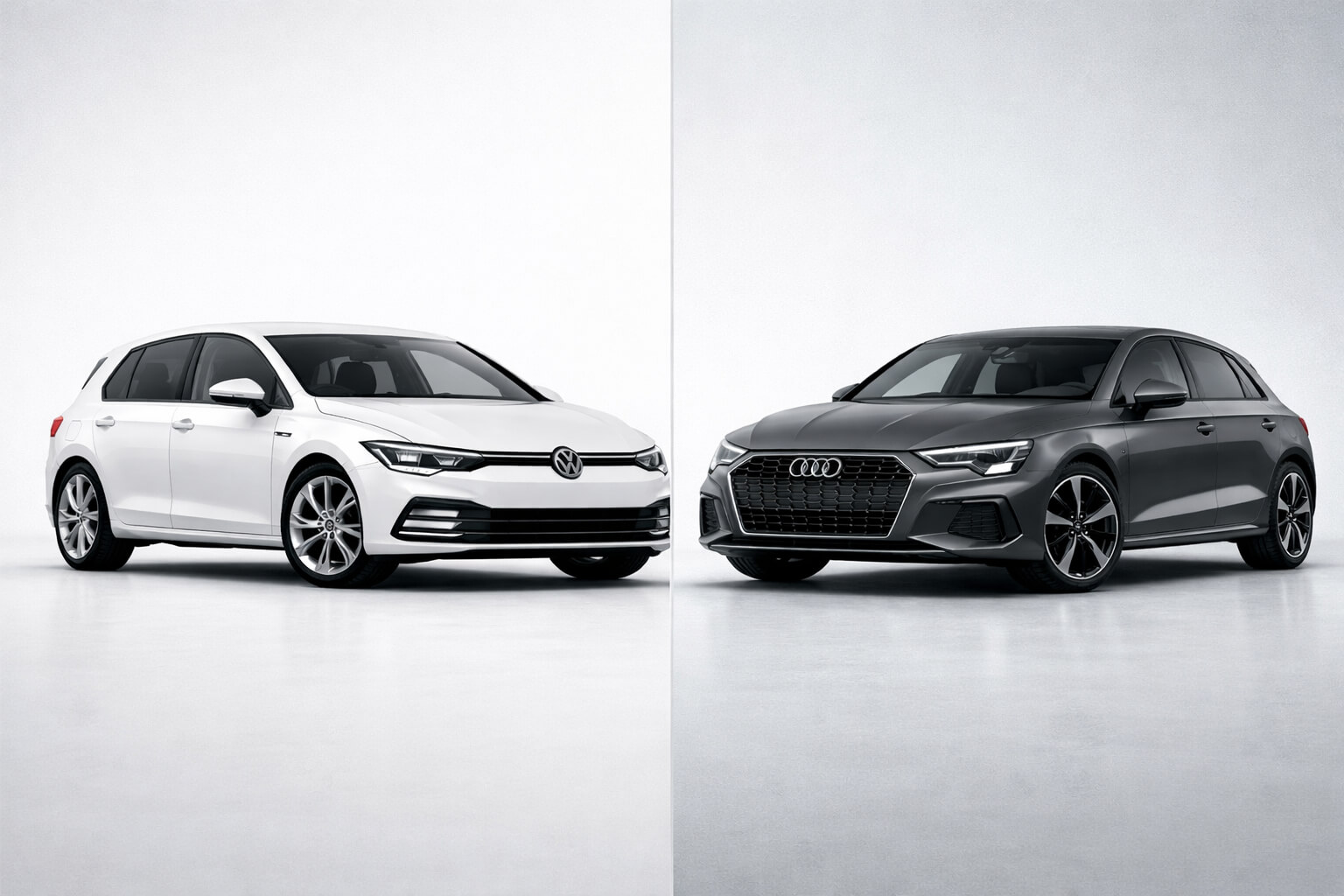
The Volkswagen Golf and Audi A3 are two hatchbacks that have people scratching their heads because both are familiar and easy to live with. On the surface, these cars feel very similar, but little details in style, tech, and how they drive make a difference in everyday life.
Let’s take a closer look at each and see what might click with you.
Quick comparison at a glance
This table compares the Audi A3 vs Golf across key areas:
MK7 Golf | 3rd Generation A3 | |
Engines | 1.0-2.0 TSI petrol, 2.0 TDI diesel, eHybrid/PHEV, GTI/R performance models | 1.0-1.8 TFSI petrol, 1.6-2.0 TDI diesel, e-tron PHEV, S3/RS3 sporty variants |
Power (bhp) | 108-320 | 103-394 |
Transmission | Manual & DSG automatic | Manual & automatic, quattro 4WD optional |
Ride & handling | Comfortable with neat handling, adaptive DCC optional | Agile and precise, dynamic suspension recommended for comfort |
Interior space | More spacious, practical boot | Slightly tighter, more premium, boot is smaller, reduced on quattro |
Reliability | Mixed | Stronger |
Running costs | Reasonable | Slightly higher |
Price comparison
Interestingly, the A3 gives you a premium feel for a little less. Looking at older models, a 2018 Audi A3 goes for around £6,700-£8,000, and a 2018 Golf is a bit pricier at £7,800-£10,000.
In the new car market, the 2026 A3 ranges from £30,830 to £43,300, and the 2026 Golf sits slightly at £28,895-£44,200.
Volkswagen Golf vs Audi A3: Size and dimensions
VW Golf hatchback:
- Length: 4,255-4,280 mm
- Width: 1,791-1,799 mm
- Height 1,435-1,514 mm
Audi A3 hatchbacks:
- Length: 4,237 mm (3-door), 4,310 mm (5-door)
- Width: 1,777 mm (3-door), 1,785 mm (5-door)
- Height: 1,421 mm (3-door), 1,421 mm (5-door)
The difference between the two is subtle but noticeable inside. The Golf feels a bit more spacious and versatile, and the A3 is sleeker and more compact.
Engine options
The Audi A3 range comes with a variety of engines. Petrol options include the 1.0-litre three-cylinder unit and the 1.5-litre 35 TFSI, and diesels range from a 1.6-litre 30 TDI to a 2.0-litre 40 TDI. There is also a high-performance S3 with a 2.0-litre petrol engine.
Transmission choices include smooth-shifting manuals and automatic gearboxes, and four-wheel-drive is available on select models for added traction. The A3 also offers a plug-in hybrid, the GTE.
The Volkswagen Golf comes with a similarly wide line-up. Petrol engines include the 1.0-litre unit and a 1.5-litre TSI; diesels feature 2.0-litre TDI options. The range also includes a sporty GTI, powered by a 2.0-litre petrol engine, and a plug-in hybrid TFSI e. Gearbox options cover both manual and automatic transmissions, and selected models offer all-wheel drive.
Performance
The Golf has a steady feel on the road, with front and rear suspension setups that absorb bumps well, especially on standard models. The car feels easy to drive around town or on longer journeys, and engines like the 1.5 TSI 150 or 2.0 GTI provide nippy responses when needed.
Higher-spec models benefit from sports suspension or the optional Dynamic Chassis Control, which allows drivers to adjust the ride for Comfort, Normal, or Sport, improving driving dynamics.
The A3 delivers a similarly controlled ride that makes it easy to handle in traffic and on open roads. The car responds more sharply and predictably in S line or higher-powered versions with firmer suspension setups. Engines like the 1.5 TFSI and 2.0 S3 are responsive across the rev range, giving the A3 a lively character.
Interior
Front headroom and legroom in the Golf are generous for occupants to find a relaxed driving position. The rear seats are practical for two adults, though taller passengers will feel slightly constrained. The dashboard is clean and logically arranged, with intuitive placement of controls and a focus on everyday practicality. The materials are strong and durable, and the interior feels reliable and built to last.
The A3 has a more polished feel, with higher-quality materials throughout the cabin. Front legroom and headroom are ample. The rear seats, though slightly less spacious than the Golf, are thoughtfully shaped to support adult passengers on shorter journeys.
Boot space
In terms of boot space, the VW Golf offers a practical and versatile setup. With the rear seats in place, it provides 380 litres of capacity, which expands to around 1,237 litres when the seats are folded down. The layout is straightforward, and the wide opening makes it easy to load shopping, sports gear, or a fold-up buggy. Higher-spec models add a flat load floor and optional split-folding seats.
The Audi A3 has a slightly smaller boot capacity. In the five‑door Sportback, luggage space is around 380 litres. The three‑door hatchback version has a smaller boot of around 365 litres, reflecting its more compact body. Quattro versions reduce boot space by around 40 litres because of the extra drivetrain components beneath the load floor.
Technology
The Golf comes with a 10.0‑inch touchscreen in most trims and a 10.25‑inch digital driver display. It supports Apple CarPlay and Android Auto, as well as built-in sat-nav, Bluetooth connectivity, and wireless phone charging. Although the system looks modern, its touch-sensitive controls and menu layout can be fiddly and harder to use than earlier or rival models.
The A3 features Audi’s MMI infotainment system, originally with a 7.0‑inch screen and, in facelifted models, a Virtual Cockpit digital display was added. Apple CarPlay and Android Auto are also supported, and the menus are generally intuitive.
Safety and driver assistance
Both the Audi A3 and the Golf received full five-star Euro NCAP safety ratings.
Golf’s standard active safety technology includes automatic emergency braking, lane-keeping assistance, and blind-spot monitoring on higher trims. Adaptive cruise control is available on mid- and high-level models. Higher-spec Golfs also have front and rear parking sensors, keyless entry, and optional Car-to-X connectivity.
The A3 provides a range of driver assistance systems, including semi-autonomous traffic jam assist, lane departure warning, and optional adaptive cruise control. The A3’s strong crash safety is matched by a well-built cabin, and quattro models add extra grip and stability in tricky conditions.
Running costs and ownership
Here’s how the VW Golf vs Audi A3 compare when it comes to the costs of keeping them on the road.
Fuel and energy efficiency
The Golf petrol models return between 52-54 mpg on the WLTP cycle, and diesel variants can exceed 62 mpg in real-world conditions. Hybrid versions, like the GTE, offer impressive official figures (up to 256 mpg), though actual consumption depends heavily on charging frequency.
The A3’s engines are similarly efficient. Small petrol units achieve around 50-60 mpg, and diesels comfortably reach the mid-50s. Plug-in hybrid models, such as the Audi A3 Sportback e-tron, offer about 176 mpg.
Insurance
Insurance for the VW Golf and Audi A3 varies according to engine size, trim, and driver profile.
The Golf sits in moderate groups (7-34), and the A3, as a premium car, is slightly higher (14-46), especially for S line or performance versions. Lower-powered models are easier to insure for younger drivers with a good record, but high-performance cars like the Golf GTI or A3 RS3 fall into much higher brackets.
Servicing
The Golf benefits from a three-year/60,000-mile warranty from new, with servicing considered reasonably priced compared with rivals. Standard maintenance includes oil changes, checks, and software updates, with optional dealer plans for extended coverage.
The A3 follows a two-year or 19,000-mile servicing schedule, with main dealer plans available that provide fixed-cost interim and full services.
Tax
Audi’s standard road tax is slightly higher than mainstream hatchbacks like the Golf, usually around £195 per year for petrol and diesel models. High-performance RS3 variants pay the extra luxury car tax of £425 if their original purchase price was over £40,000.
The VW Golf’s road tax is lower, ranging from £20 to £215 per year.
Depreciation
The Golf keeps its value well due to its practicality and wide appeal. The Audi A3 also holds its price, thanks to its premium feel and strong demand, though high-performance or niche models tend to lose value faster.
How Carplus can help with financing the car you want
Whether you’re looking for a VW or an Audi, at Carplus, we are here to help you explore your financing options and make the process clear and manageable. We connect you with a network of trusted, licensed lenders and allow you to set a deposit, repayment period, and monthly payments that match your budget.
Throughout the process, we’re on hand to answer your questions and guide you step by step. Check your options!
Who is the Volkswagen Golf for?
The Golf is a practical family hatchback that delivers a reliable and engaging driving experience. It works well for drivers who want a car that handles daily driving easily while feeling steady on the road.
Who is the Audi A3 for?
The Audi A3 appeals to people who value a premium brand and the status that comes with its badge. It’s a bit easier to use, but most people buy it for the sense of style and comfort.
Verdict
The Golf and A3 are both great choices. Driving either car gives a sense of ease and control, and their presence on the road is quietly confident. Other people notice them for their understated style, and drivers often find themselves moving through traffic smoothly. Safe travels!
Table of Contents