




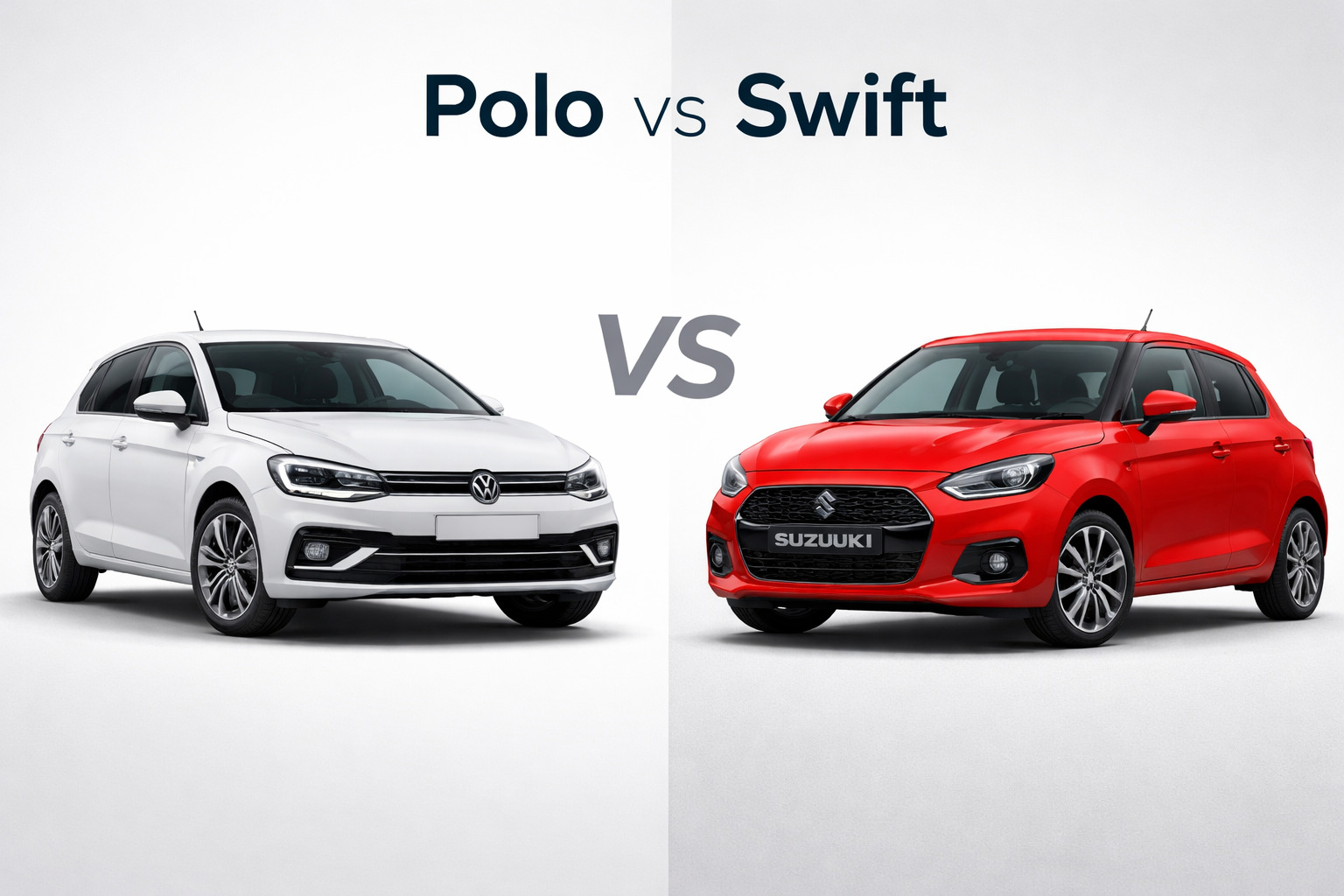
There are many comparisons in the hatchback segment, but some models keep coming up. For instance, the Volkswagen Polo and Suzuki Swift are some strong contenders.
The Swift’s compact dimensions and lower kerb weight make it feel nimble in town and efficient on fuel. The Polo has a slightly larger body that translates into a noticeably bigger boot and a more planted ride. Both are practical five-seat hatchbacks, but that contrast in character is what makes choosing between the Suzuki Swift or Volkswagen Polo genuinely tricky. Let’s break it down!
Quick comparison at a glance
Here’s a side-by-side look at the Suzuki Swift vs Volkswagen Polo:
Suzuki Swift | Volkswagen Polo | |
Overall character | Light, fun-to-drive, efficient | Comfortable and grown-up |
Performance feel | Lively, especially 1.0 SHVS hybrid | Adequate to brisk, depending on the engine |
Ride comfort | Firm, can feel harsh over bumps | Supple and comfortable |
Handling | Tidy, confidence-inspiring, light on its feet | Safe and predictable rather than fun |
Noise levels | Noticeable road and wind noise | Quiet on the move, especially on motorways |
Interior space | Good headroom, decent rear space | Very spacious for a small car |
Interior quality | Solid but cheap-feeling plastics | Classy, high-quality interior |
Reliability reputation | Terrific reliability, very dependable | Mixed reliability, electrical issues reported |
Price comparison
When you compare prices, the Swift and Polo show some interesting differences. A 2018 Polo usually goes for around £7,000-£8,000, and a 2018 Swift Sport is a bit easier on the wallet at £5,000-£6,500.
Looking at new cars, the 2026 Polo starts from £22,040, and a new Swift Sport begins at £19,699.
Volkswagen Polo vs Suzuki Swift: Size and dimensions
Suzuki Swift:
- Length: 3,840 mm
- Width: 1,735 mm
- Height: 1,495 mm
VW Polo:
- Length: 4,074 mm
- Width: 1,751 mm
- Height: 1,451 mm
The Polo’s extra length and width give it more interior and boot space. In contrast, the Swift’s greater height offers better headroom and a slightly more upright driving position.
Engine options
The Suzuki Swift offers a choice of three-cylinder engines. There’s a 1.2-litre petrol engine producing 89 bhp, available with a manual gearbox, and the 1.0-litre Boosterjet three-cylinder turbo producing 109 bhp, which can come with a mild-hybrid system for better fuel economy.
Entry-level Swifts come with a 5-speed manual or AGS, mid-range models use a CVT automatic, and the sporty Swift Sport features a 6-speed manual. The 1.2‑litre engine is the only one available with the Allgrip four-wheel-drive system on certain models.
The Volkswagen Polo provides a wider range of engines, starting with an entry-level 1.0‑litre three-cylinder engine producing 64 bhp, 74 bhp, or 79 bhp. More powerful turbocharged three-cylinder options deliver 94 bhp or 114 bhp. There’s also a four-cylinder 2.0-litre petrol engine in the GTI and a 1.6‑litre diesel in 79 bhp and 94 bhp variants.
Higher-spec Polos can be paired with a seven-speed dual-clutch automatic. Lower-power engines use either a manual gearbox or CVT, depending on the model.
Performance
When it comes to performance and handling, the Swift truly punches above its weight, being highly agile and responsive despite its compact size. Its power and torque are well-matched to the lightweight chassis, and the powertrain delivers a lively, engaging drive, especially in the Swift Sport. The ride quality is firm yet comfortable, which is helped by a torsion beam rear suspension that keeps the car composed around corners.
That said, the car sometimes feels harsh over rough roads, especially compared with more comfort-oriented rivals. Road and wind noise are also more noticeable, particularly at motorway speeds.
The Polo offers a more refined drive, with predictable handling and light, easy steering. However, it feels less playful behind the wheel compared with the Swift. In most cases, the Polo leans towards safety and comfort, but sportier versions like the GTI add more urgency and responsiveness.
Also, this car excels on long-distance drives, with remarkably low wind and road noise at motorway speeds.
Interior
The Swift’s interior is practical, with front seats that are comfortable and plenty of headroom for the driver and front passenger. Storage includes map pockets and door bins, but the cabin is rather basic, with hard, shiny plastics and a smaller boot.
Visibility is good from all seats, which helps with tight-city parking and manoeuvring, and the controls are laid out intuitively.
The Polo prioritises front and rear seat space and overall cabin versatility. Legroom is generous for rear passengers, and headroom is also very comfortable, even for taller occupants. The seats are supportive for longer journeys, and the cabin feels more refined thanks to the higher-quality materials used, which are uncommon in smaller hatchbacks.
The centre armrest is well-positioned for front occupants, and storage in the centre console and door bins helps with everyday practicality. The layout keeps controls and infotainment within easy reach.
Boot space
With the seats up, the Swift offers 265 litres of space. However, lifting heavy items over the lip can be tricky, as it doesn’t have a variable-height floor.
The Volkswagen Polo is more spacious, providing 351 litres with the rear seats up. Folding the seats down adds even more cargo capacity, up to 1,125 litres in total. Many Polo trims, including SE and above, also have a variable-height boot floor, which removes the load lip and makes loading heavy or bulky items easier.
Technology
The Suzuki Swift is well-equipped for its class. The mid-range Swift SZ-T comes with a 7.0-inch touchscreen and Apple CarPlay and Android Auto. Higher trims like Swift GLX offer extra tech like LED projector headlamps with a guide-me-home function, push-button start, and more.
The Volkswagen Polo also offers strong technology. Even the entry-level S trim comes with an 8.0-inch touchscreen, USB ports, and smartphone connectivity via App Connect. Higher trims add dual-zone climate control, keyless entry, and enhanced infotainment options.
Safety and driver assistance
There is a clear difference in Euro NCAP safety ratings between the two cars: the Swift scores three stars, and the Polo achieves five. The Swift comes with a decent range of basic safety features, including airbags and stability aids, but it doesn’t offer the same level of active safety technology or driver assistance systems as the Polo.
With Polos, even entry-level models include automatic emergency braking and cruise control, not to mention all the standard safety features, such as stability control, airbags, and seatbelt reminders. Higher trims add rear parking sensors, adaptive cruise control, lane departure warning, and more.
Running costs and ownership
This section gives a clearer picture of what it’s like to live with these cars day to day.
Fuel and energy efficiency
The Suzuki Swift is very economical, with impressive fuel consumption figures across the range. The 1.0 litre mild-hybrid turbo and the 1.2 litre petrol both return around 65.7 mpg. As for mid-range models, the 1.2‑litre Allgrip averages 62.8 mpg. Even the automatic 1.0 manages 56.5 mpg.
The Volkswagen Polo also performs well, with small petrol engines returning 58.9-62.8 mpg, the 1.6 TDI diesel reaching 76.3 mpg, and only the 197 bhp GTI being less efficient at 47.9 mpg.
Insurance
Swifts fall into reasonable insurance groups in the 20s, and most Polo models also benefit from low insurance groups. Only the GTI sits in higher insurance brackets.
Servicing
Servicing a Swift is in line with rivals. Suzuki offers three-year service plans for cars up to six years old, and approved used cars come with a 12-month warranty. Polo servicing is slightly cheaper than similar rivals, but dealer repair costs can be higher.
Tax
Road tax for the Swift is usually £190 per year, or £180 for SHVS mild-hybrid models. The Polo attracts a similar flat-rate fee of £195 for petrol and diesel models registered after April 2017.
Depreciation
Both cars hold their value reasonably well. Older Swifts and Polos have already seen the biggest drops, but newer models retain more value. Sportier or better-equipped trims tend to depreciate more slowly.
How Carplus can help with financing the car you want
There are many hatchbacks that are worthy of your attention, but probably the second most important element is how you pay for the one you choose. At Carplus, we help by offering simple, flexible financing.
The process is simple: choose your car, pick a financing plan that fits your budget, and we’ll help you set up your payments. You can adjust the monthly payments and loan length to make it comfortable for you. Ready to get started? Check your options online!
Who is the Volkswagen Polo for?
The Polo is a better option for anyone looking for a practical and spacious city car. It’s great if you need extra interior room for passengers or luggage, or if you regularly commute in urban areas. The car is quiet and predictable, and you’ll feel assured every time you drive it.
Who is the Suzuki Swift for?
The Swift is perfect for anyone who wants a small hatch that’s light, nimble, and fun to drive. Its higher ground clearance makes it more adaptable to uneven roads or rural routes, and the strong fuel economy keeps running costs low.
Verdict
When it comes to Polo vs Swift, the choice ultimately comes down to your life and style preferences. Both deliver value in their own way, but it depends on whether you lean towards practicality or spirited city driving. Enjoy the ride!
Table of Contents