




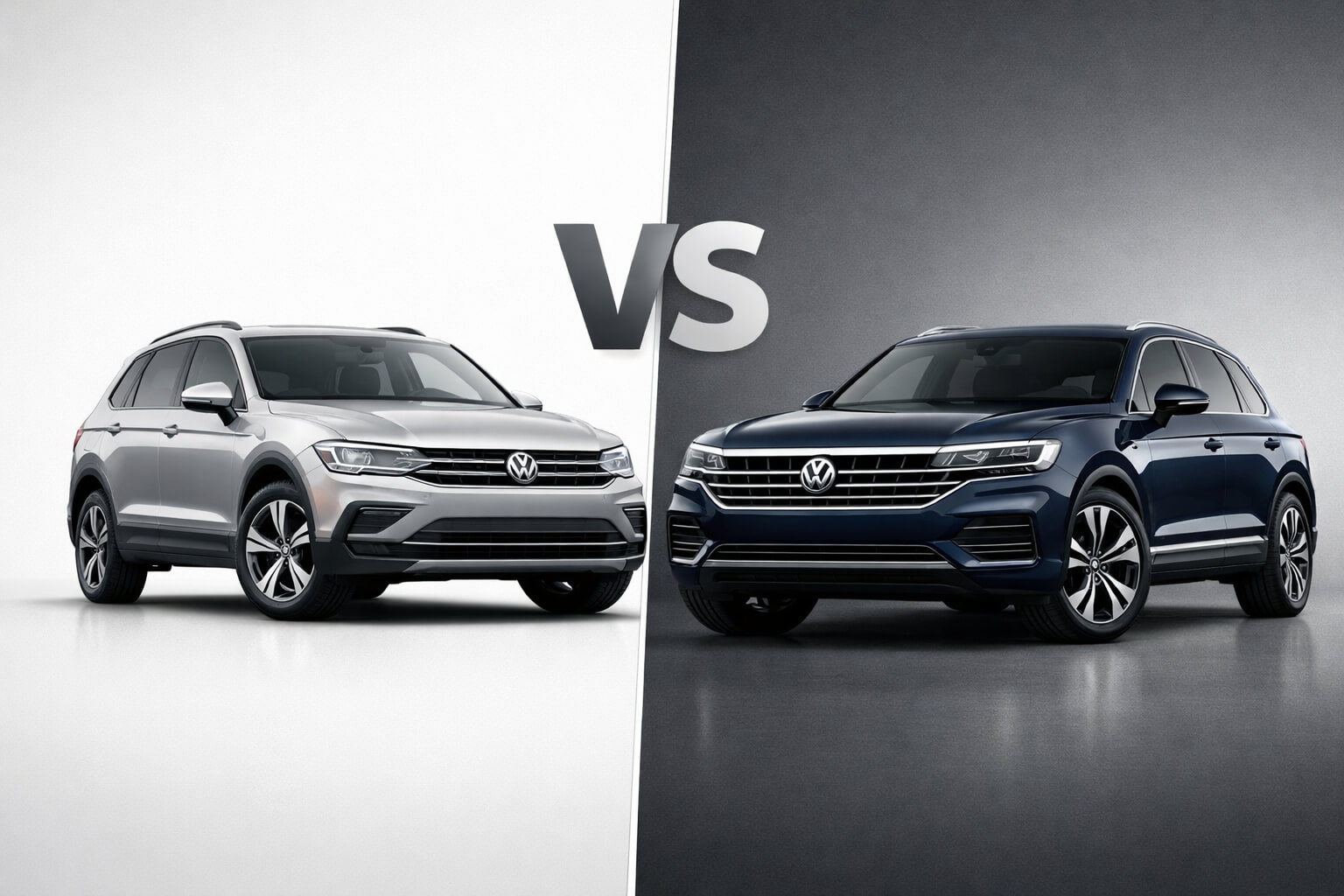
If you’re eying Volkswagen SUVs, chances are you want something practical, reliable, and a little fun to drive.
The Volkswagen Tiguan and Volkswagen Touareg fit the bill perfectly. One is compact and city-friendly, the other is bigger and more luxurious, but they both deliver the kind of experience that keeps people coming back. Let’s see how each one measures up to make sure it’s the perfect fit.
Quick comparison at a glance
Here’s a quick comparison overview of the Volkswagen Tiguan vs Volkswagen Touareg:
T-Roc | Tiguan | |
Engines | Petrol: 1.0-2.0 TSI, diesel: 2.0 TDI, T-Roc R up to 296hp | Petrol: 1.5-2.0 TSI, diesel: 1.5-2.0 TDI, eHybrid PHEV up to 227hp |
Performance (0-62mph) | 10.6 s (standard) / 4.9 s (R) | 7.2 s (PHEV) / 8.5 s (2.0 TSI) |
Ride & handling | Light steering, comfortable, sporty feel, good cornering | Composed, commanding SUV feel, comfortable for long drives |
Practicality | Smaller boot, slightly tighter rear seats, flexible for class | Spacious rear seats, very large boot, flexible seating (Allspace 7-seater) |
Strengths | Cheaper, sporty feel, compact, practical for small families | More spacious, premium interior, versatile, PHEV option |
Weaknesses | Smaller, less premium, no hybrid | More expensive, heavier |
Price comparison
Price is one area where you see some major differences, especially in the new car market. The new Tiguan (2025/2026 models) starts from £38,000 and can go up to £53,000, whereas the 2026 Touareg sits in a higher bracket at £71,700-£74,500.
For used Volkswagen models, a 2018 Tiguan costs around £9,000-£11,000. A 2018 Touareg is slightly more expensive at £9,000-£10,900, but these figures apply to high-mileage examples only. Most models fall into higher price brackets.
Volkswagen Tiguan vs Touareg: Size and dimensions
VW Tiguan:
- Length: 4,539 mm
- Width: 1,859 mm
- Height: 1,660 mm
VW Touareg:
- Length: 4,902 mm
- Width: 1,984 mm
- Height: 1,712 mm
The Touareg, a mid-size SUV, is a bigger vehicle than the Tiguan, which gives it more interior space, a larger boot, and a stronger road presence. However, on the Tiguan’s side, it is more compact, easier to park, and handles city driving better.
Engine options
The Tiguan is available with a variety of petrol and diesel options. Early petrol options included a 1.4-litre TSI and later a 1.5-litre TSI, and the diesel line-up featured several 2.0-litre engine variants. Most Tiguan models come with a choice of front-wheel drive or four-wheel drive, paired with a smooth-shifting eight-speed automatic on higher trims.
The Touareg is offered with larger engines, including a 3.0-litre V6 diesel available in 228bhp and 335bhp forms, as well as a 3.0-litre petrol option. There is also a plug-in hybrid combining a 3.0-litre petrol engine with electric motors. All Touaregs are equipped with eight-speed automatic gearboxes and standard four-wheel drive, in line with the Touareg’s larger dimensions and role.
Performance
Behind the wheel, the Tiguan delivers a firm yet comfortable ride. Its suspension smooths out road imperfections and speed bumps, but it still gives enough feedback to make cornering predictable. Steering is precise, which helps with manoeuvring in tight urban areas, and optional four-wheel drive improves traction on slippery surfaces.
The Touareg feels more substantial due to its size, but the air suspension and four-wheel steering make handling surprisingly agile. The rear wheels turn slightly at low speeds to reduce the turning circle and make parking easier. Road and wind noise are well controlled at motorway speeds, though larger wheels transmit more bumps. The Touareg can cope with off-road terrain when needed, and the firm suspension on R-Line models gives a sportier ride on country roads (though slightly harsher).
Interior
The Tiguan’s cabin is spacious, with soft-touch materials, and the dashboard is clear and intuitive. The second row of seats provides good rear legroom and headroom, comfortably seating five occupants. The optional third row in the Allspace variant is suitable for short trips or smaller passengers.
Storage space is plentiful, with door bins, cupholders, a large glovebox, and a flexible boot. The seats slide, recline, and split-fold in a 40/20/40 layout.
The Touareg offers a larger interior, with more headroom and legroom throughout. The rear seats are comfortable for longer journeys, and storage includes a large boot with a shallow loading lip and underfloor compartments. The cabin is solidly built, with a premium feel that reflects its bigger size and luxury positioning.
Boot space
The Touareg provides a roomier boot. It offers 520 litres up to the luggage cover, which can expand to 615 litres if you slide the back seats, and up to 1,650 litres if you fold them. The low loading lip, wide opening, and 40/20/40 split-folding rear seats make it easy to stow bulky items.
The Tiguan, while more compact, is still versatile. It offers 652 litres with the rear seats in place and an impressive 1,800 litres with the seats folded. Though the Tiguan’s boot isn’t quite as spacious as the Touareg’s, it handles daily errands, supermarket runs, and weekend trips without any trouble.
Technology
The Tiguan comes with a practical, user-friendly technology package, centred around its 8-inch infotainment touchscreen in older models and 12.9-inch display in newer ones. This system supports Apple CarPlay and Android Auto for apps, music, and navigation on the go. Higher-spec models add ambient lighting in the front footwell, keyless entry with the key fob, and a Start/Stop button on the centre console, but the core setup is the same.
The Touareg leans towards a more premium and immersive technology experience. The system also supports Apple CarPlay and Android Auto, along with enhanced vehicle settings, navigation, and media management through the larger 15-inch infotainment touchscreen on higher trims. In addition, it features a head-up display, an electric boot lid, and optional four-zone climate controls.
Safety and driver assistance
The Tiguan and Touareg both earned strong Euro NCAP safety ratings and come equipped with a suite of active driver-assist technologies. Both SUVs feature adaptive cruise control, automatic emergency braking, driver fatigue detection, and lane-keeping assistance.
The Touareg adds more advanced safety and convenience features thanks to its premium positioning, including a 360-degree camera system, parking assistance, blind-spot monitoring, and collision warning with pedestrian recognition.
Running costs and ownership
Day-to-day costs are another key difference between the Tiguan and Touareg:
Fuel and energy efficiency
The Tiguan offers good real-world fuel economy. The 1.5 TSI petrol engines return around 44.8 mpg in 128bhp form and 40.4 mpg with 148bhp. The 2.0 TDI diesel is more efficient with roughly 50.4 mpg. In everyday use, this means the Tiguan can cover long distances on a single fuel tank.
The Touareg, being larger and heavier, is less efficient overall. Diesel versions manage around 34.4 mpg, which is reasonable for a full-size SUV. The petrol V6 drops to about 26.6 mpg. The plug-in hybrid Touareg R returns around 95.2 mpg, but this depends on frequent charging and short journeys in electric mode.
Insurance
The Tiguan sits in insurance groups 18-32, depending on engine and trim. The Touareg falls into much higher insurance groups 39-49, which reflects its larger engines, higher value, and luxury SUV status.
Servicing
The Tiguan benefits from fixed-price servicing on older models:
- Minor service: around £184
- Major service: around £354
The Touareg is not yet eligible for fixed-price servicing. However, Volkswagen servicing is still cheaper than most premium-brand rivals, even if it’s noticeably more expensive than the Tiguan.
Tax
Most Tiguan models registered after April 2017 pay the standard flat VED rate (currently £195 per year), with only higher-spec versions triggering the luxury surcharge.
Every Touareg costs over £40,000 when new, so all versions attract the luxury car tax surcharge. This means owners pay the standard rate plus the additional charge (currently £425 per year) during years two to six of ownership.
Depreciation
The Tiguan depreciates more slowly, supported by strong demand in the used family SUV market. The Touareg suffers from heavier early depreciation, which is typical of large luxury SUVs.
How Carplus can help with financing the car you want
If you’re weighing up a Volkswagen Tiguan vs Volkswagen Touareg comparison and wondering how to afford the car you ultimately choose, Carplus helps make it easier.
Carplus offers flexible car financing options for different budgets and ownership plans. We’ll guide you through personalised loans, explain what deposits and interest to expect, and help you understand what fits your financial situation.
Check your eligibility and secure the car you want!
Who is the Volkswagen Tiguan for?
The Tiguan feels like a practical and well-rounded SUV and is a strong choice for families. Its spacious interior, flexible seating, and ample boot space are great for school runs, grocery trips, and weekend getaways. Also, you get capable driving and sensible fuel use in the Tiguan.
Who is the Touareg for?
The Touareg is made for buyers who value a refined interior and technology. Its cabin is spacious, with advanced infotainment and driver-assistance features that make the experience easier and more comfortable.
Verdict
In this VW Tiguan vs Touareg car comparison, the choice comes down to size and purpose: choose the Tiguan for a compact, practical SUV or the Touareg for a bigger, more spacious vehicle. Either way, you won’t go wrong because each delivers value in its segment.
Table of Contents